ॐ श्री गणेशाय नमः ॥ जय श्री राम ॥
Decoding the Cosmic Dream
The Timeless Wisdom of Yoga Vāsiṣṭha
योगवासिष्ठ — वैराग्यप्रकरणम् — प्रथमः सर्गः
यतः सर्वाणि भूतानि प्रतिभान्ति स्थितानि च ।
यत्रैवोपशमं यान्ति तस्मै सत्यात्मने नमः ॥ १ ॥
ज्ञाता ज्ञानं तथा ज्ञेयं द्रष्टा दर्शनं दृश्यभूः ।
यस्यैव स्फुरणं सर्वं तस्मै सत्यात्मने नमः ॥ २ ॥
स्फुरन्ति सीकरा यस्मादानन्दस्याम्बरेऽखिलाः ।
सर्वेषामूवनं यस्मात्तस्मै सत्यात्मने नमः ॥ ३ ॥
Salutations to that Supreme Truth (Satya Ātman), from which all beings arise, in which they exist and shine forth, and into which they finally dissolve in peace.Salutations to that Supreme Reality which alone appears as the knower, knowledge, and the known; the seer, seeing, and the seen. All manifestations arise through its own radiance.Salutations to that infinite Consciousness from whose ocean of Bliss the countless droplets of creation emerge and play in the vast sky of awareness.
These opening verses beautifully establish the heart of Yoga Vasistha. The text begins not with ritual, dogma, or theology, but with Consciousness itself — the eternal substratum behind all existence. In just a few verses, the scripture introduces its bold central insight: the world we experience is inseparably linked to the movements of consciousness and mind. Liberation, therefore, is not merely a change in external circumstances, but a profound shift in understanding.
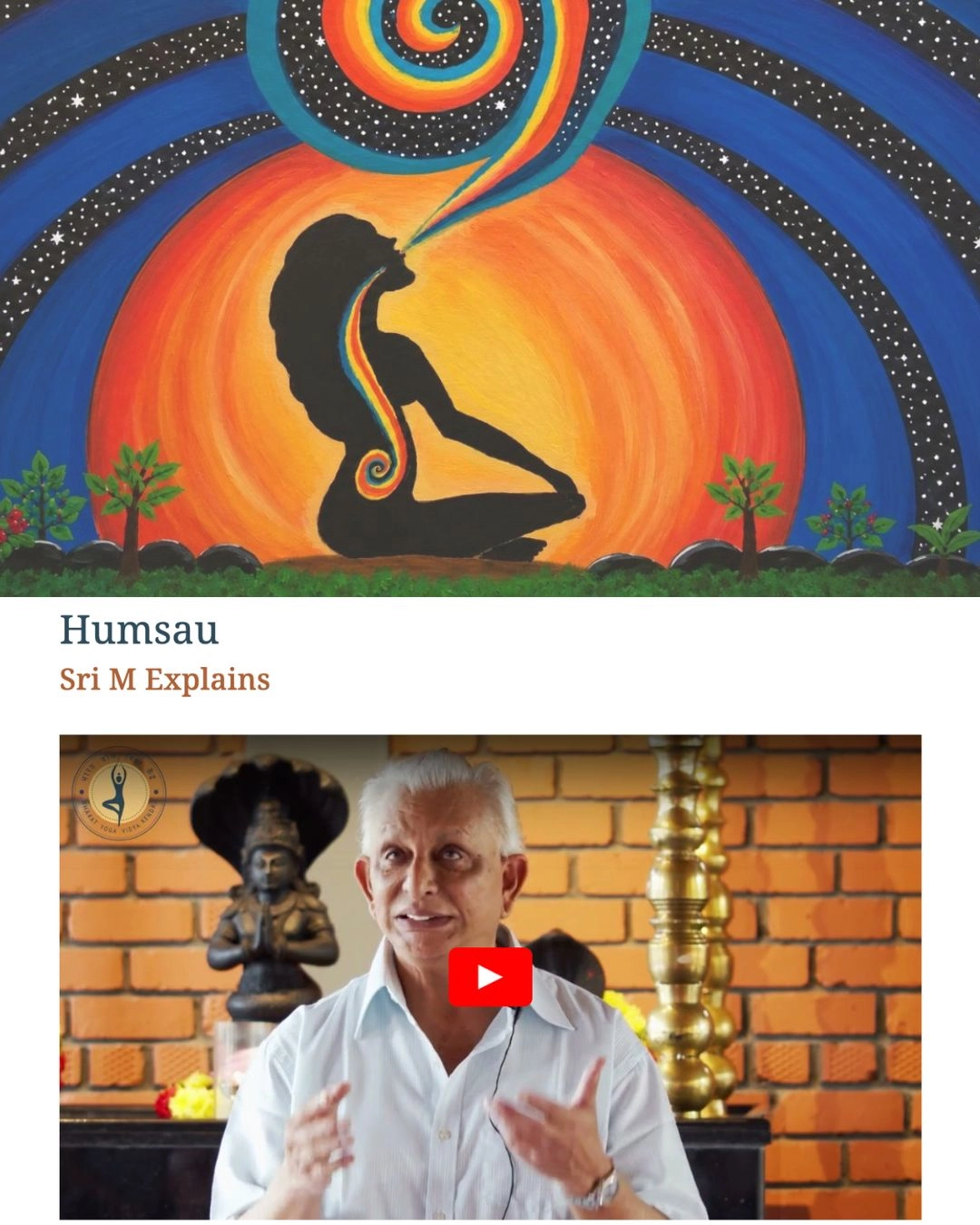
Opening Prayer and Invocation by Sri M Prayer
The Divine Play of Lord Nārāyaṇa
According to the traditional understanding, Supreme Lord Nārāyaṇa — the infinite ocean of Consciousness — incarnated on earth as Prince Rāma. Though the ruler of the cosmos, he willingly veiled his divine omniscience and assumed the role of a sincere human seeker experiencing confusion, sorrow, and existential despair.
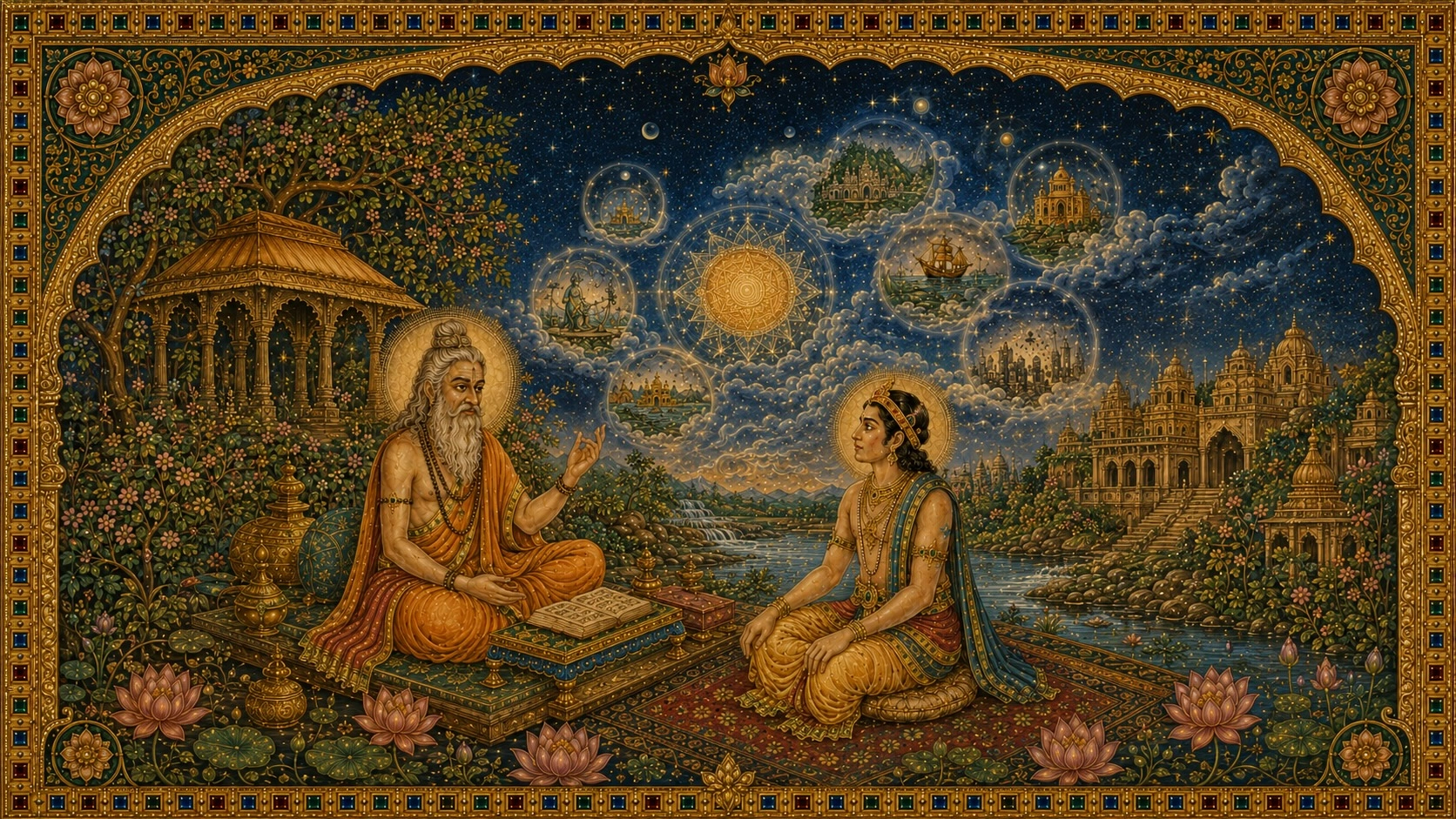
This divine play (līlā) serves a sacred purpose. By placing himself in the position of one deeply troubled by the impermanence of worldly life, Rāma becomes the ideal student through whom Sage Vasiṣṭha delivers the highest spiritual wisdom to humanity. Through their dialogue, timeless truths about mind, suffering, reality, and liberation become accessible to all seekers across generations.
The Context: Rāma’s Existential Crisis
Traditionally attributed to Maharṣi Vālmīki and set in the Tretā Yuga, the Yoga Vāsiṣṭha opens not with a battle or royal triumph, but with an existential crisis. After returning from a pilgrimage across the land, the young Prince Rāma becomes deeply disturbed by the transient nature of life. Wealth fades, youth disappears, relationships change, kingdoms crumble, and even great achievements vanish with time.
Seeing Rāma withdrawn and dispassionate, King Daśaratha requests Sage Vasiṣṭha, the royal preceptor, to counsel him. What follows is one of the most profound philosophical and psychological dialogues in world literature — comprising nearly 32,000 verses exploring consciousness, mind, illusion, destiny, free will, suffering, and liberation.
At its heart, the Yoga Vāsiṣṭha is an inquiry into the nature of the mind itself. Again and again, Sage Vasiṣṭha points Rāma inward — not toward blind belief, but toward direct observation of experience. The text boldly declares: “Mind alone is the cause of bondage and liberation.”
When clouded by desire, fear, and conditioning, the mind creates suffering. When purified through inquiry and wisdom, the same mind becomes the doorway to freedom.
The Sequential Awakening: The Six Books of Yoga Vāsiṣṭha
The six books of Yoga Vasistha are not merely philosophical categories; they map the inner evolution of a spiritual seeker — beginning with existential despair and culminating in complete liberation.
The journey begins with Vairāgya Prakaraṇa, the Book of Dispassion, where Prince Rāma becomes deeply disturbed by the fleeting nature of worldly existence. Pleasure, youth, ambition, wealth, and power suddenly appear fragile and temporary. Yet this disillusionment is not pessimism; it is the birth of spiritual maturity. Yoga Vāsiṣṭha teaches that genuine inquiry begins when one clearly sees the limitations of external fulfillment.
From this awakening arises the sincere longing for Truth explored in Mumukṣu Vyavahāra Prakaraṇa, the Book of the Seeker. Here Sage Vasiṣṭha dismantles the idea of helpless fate, explaining that what we call destiny is largely the momentum of past conditioning and action. Through conscious self-effort (puruṣārtha), transformation becomes possible. The text introduces the celebrated four gatekeepers to liberation — tranquility of mind (śama), self-inquiry (vicāra), contentment (santoṣa), and the company of the wise (satsaṅga). Even mastering one deeply, Vasiṣṭha says, can open the doorway to freedom.
Having prepared the seeker, the text then enters its profound philosophical core through Utpatti and Sthiti Prakaraṇas — the books of Creation and Sustenance. Through extraordinary stories such as Queen Līlā and countless dream-like narratives, the Yoga Vāsiṣṭha presents one of its most radical insights: the world as experienced by the individual is deeply shaped by consciousness and mind. Reality appears solid because it is continuously sustained by mental impressions (vāsanās), desires, memory, and identification. We become so absorbed in the changing forms of life that we forget their underlying essence, just as one may admire a gold ornament while forgetting it is fundamentally gold.
As understanding deepens, the seeker naturally enters Upaśama Prakaraṇa, the Book of Quietude. Here the restless movements of the mind gradually begin to dissolve through contemplation, inquiry, and detachment. Importantly, detachment in Yoga Vāsiṣṭha does not mean escaping from life. The awakened person continues to live, work, love, and serve — but without inner bondage to fear, anxiety, or compulsive desire. Peace arises not from controlling the world, but from quieting the turbulence of the mind itself.
The journey culminates in the majestic Nirvāṇa Prakaraṇa, the Book of Liberation. Here the text describes the state of the jīvanmukta — one who is liberated while still living fully in the world. This section also presents the celebrated Sapta Jñāna Bhūmikās, the seven stages of spiritual wisdom, tracing the evolution of consciousness from the first longing for Truth to complete abidance in non-dual awareness. The final revelation of the Yoga Vāsiṣṭha is both simple and profound: liberation is not becoming something new, but awakening to what one has always been — pure Consciousness itself.
Why Yoga Vāsiṣṭha Still Matters Today
What makes the Yoga Vāsiṣṭha extraordinary is how deeply relevant it feels even today. In an age overwhelmed by distraction, comparison, anxiety, overstimulation, and constant mental noise, the text speaks directly to the structure of human suffering itself. Long before modern psychology, it explored perception, identity, conditioning, attention, and the restless tendencies of the mind.
Yet the text is not pessimistic or world-denying. Its vision is profoundly liberating. The goal is not escape from life, but freedom within life — to participate fully in the world while rooted in clarity, wisdom, and inner peace.
The Yoga Vāsiṣṭha ultimately reminds us that liberation is not somewhere far away in time or space. It begins in this very moment, through inquiry, awareness, and the quiet recognition of one’s true nature.
Swadhyaya: How to Study the Yoga Vāsiṣṭha
This text is a lifelong study companion, not a novel to be rushed through. Treat each page like a sunrise—approach it fresh, reading just a page or a chapter a day to contemplate and live the teachings. For your study layout, integrate these three complementary resources:
- For Listening: Sri M’s extensive, 40-plus hour Yoga Vasishta video series recorded during his landmark retreat at the Maha Kumbh in Prayagraj, India in February 2025.
- For Daily Reading: Swami Venkatesananda’s English translation (“Vasistha’s Yoga”), highly regarded for keeping the text accessible and practical.
- For Deep Verse Analysis: The comprehensive online archive on WisdomLib, which hosts all 32,000 original verses in Sanskrit Devanagari alongside detailed line-by-line commentaries.