Happy New Year to all our readers!
As the calendar turns, we are culturally conditioned to look forward—to plan, to predict, and to resolve. Yet, Vedanta teaches us that to move forward effectively, we must first look inward. We often construct grand edifices of ambition on the shaky ground of an unprepared mind. This year, we invite you to focus on the foundation.
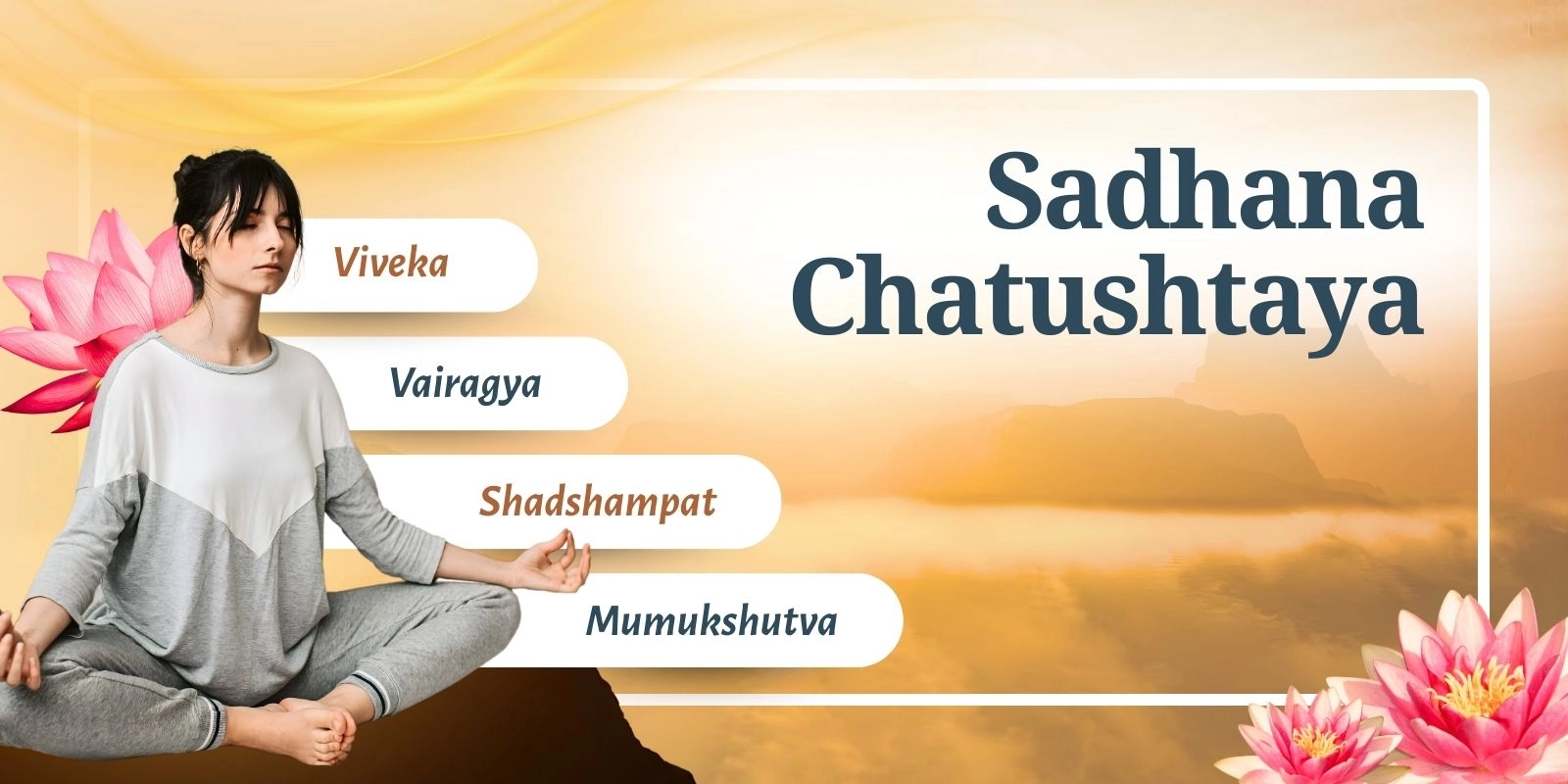
Our theme for this issue is Sadhana Chathusthaya—the Fourfold Qualifications. In a world of increasing digital distraction and emotional volatility, these qualities are the ultimate “soft skills.” They teach us how to choose the eternal over the ephemeral, how to act without entanglement, and how to weather life’s storms with a smile.
Let this issue be your blueprint. Before you build the walls of your 2026 resolutions, ensure your foundation is rock solid.
May your year be filled with clarity, strength, and inner freedom.
Om Tat Sat
Viveka
Sri M Explains
Talk with M


BLOG POST
The Four Pillars of Inner Strength
January represents a threshold—a doorway between what has been and what could be. We all stand at this threshold with lists of resolutions: to eat better, to work smarter, to be kinder. Yet, how often do we find ourselves back in old patterns by February? The ancient sages of Vedanta suggest that we often try to build the roof of a house before we have laid the foundation. In the spiritual tradition, this foundation is known as Sadhana Chathusthaya—the Fourfold Qualifications.
These aren’t just archaic rules for monks in the Himalayas. They are the psychological muscles required to navigate modern life with grace, resilience, and clarity. Whether you are managing a boardroom, a classroom, or a chaotic household, these four pillars are your toolkit for inner stability.
1. Viveka: The Art of True Discernment
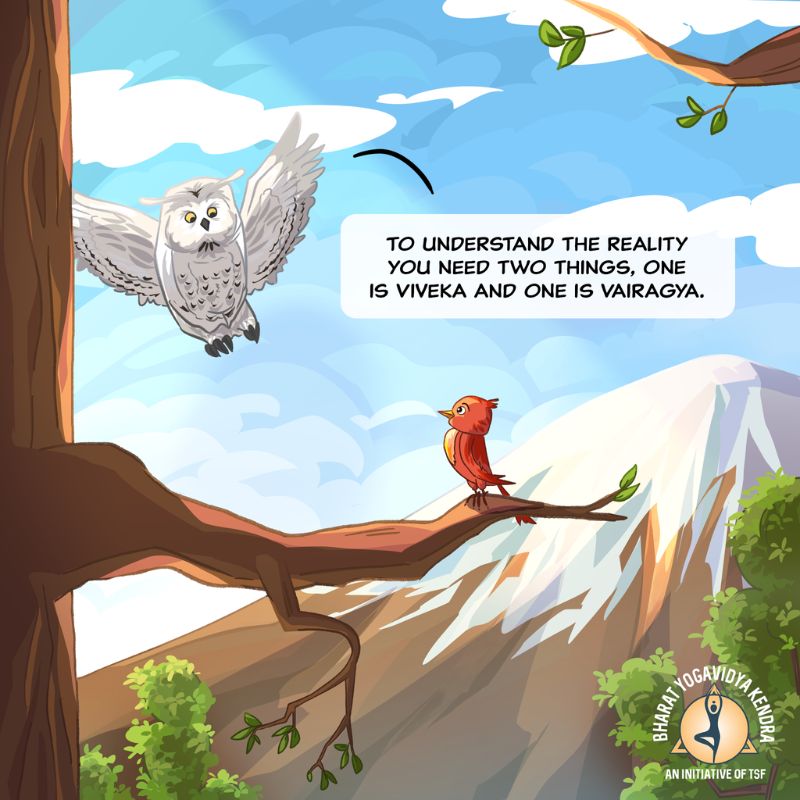
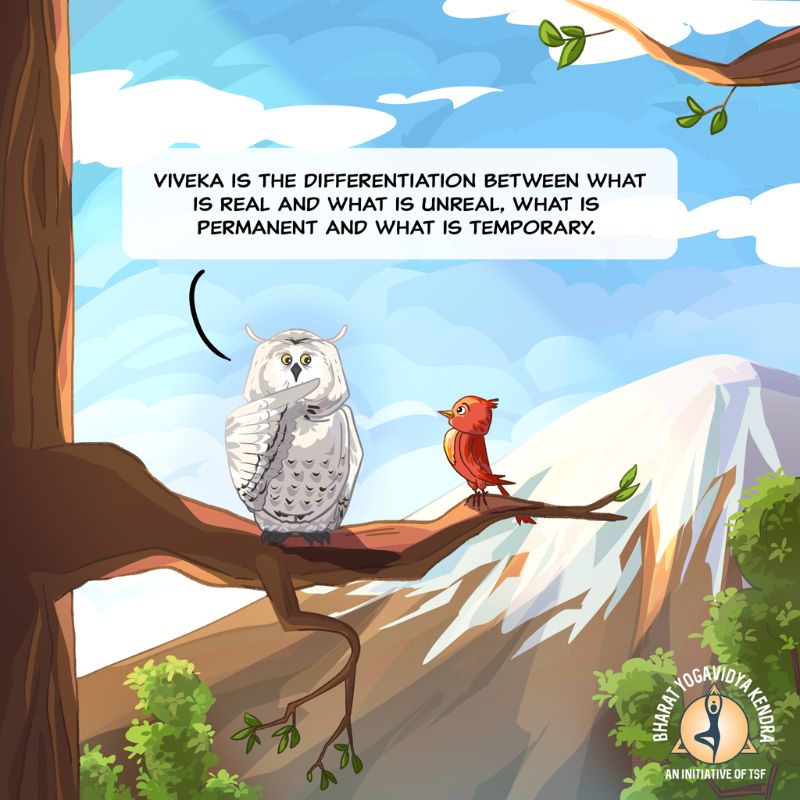
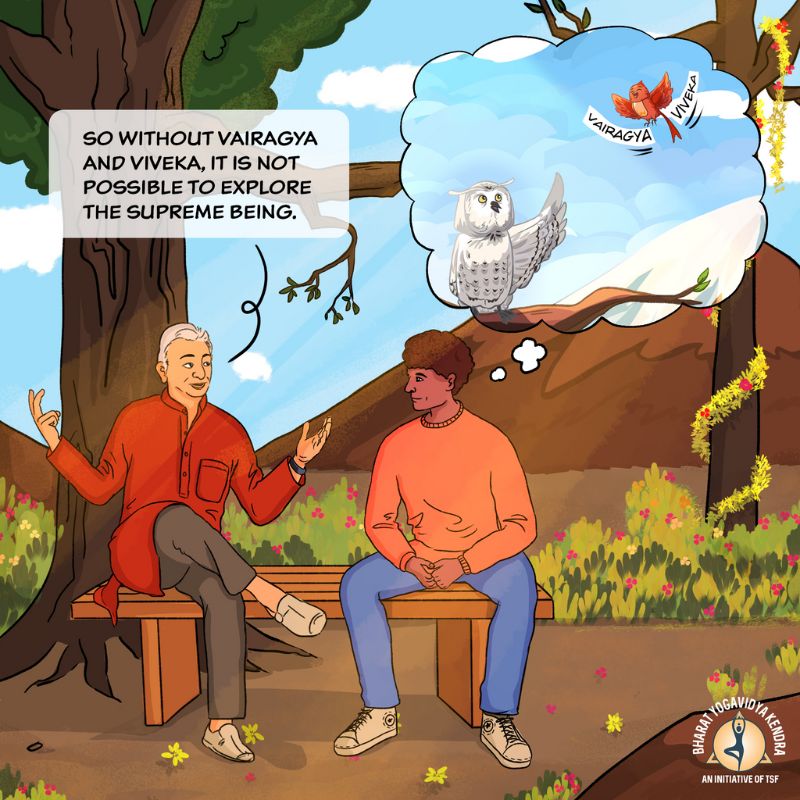
Imagine you are at a buffet. There are dishes that look colorful and sugary, and others that look simple but are nourishing. Viveka is the intelligence that chooses the nutritious over the merely tasty. In our daily lives, Viveka is the ability to distinguish between the Permanent (what feeds the soul) and the Temporary (what merely stimulates the senses).
We practice Viveka when we ask: “Will scrolling social media for another hour give me peace, or will a 10-minute walk do that?” It is the inner compass that constantly points True North, separating the noise of the world from the voice of your intuition. It separates the “Preyas” (pleasant now, painful later) from the “Shreyas” (good for the soul).
Practical Practice: This week, apply the “Two-Day Rule.” Before making a non-essential purchase or reacting to a triggering email, wait two days. Use your Viveka to see if the desire or anger is real, or just a passing cloud.
2. Vairagya: The Freedom of Dispassion
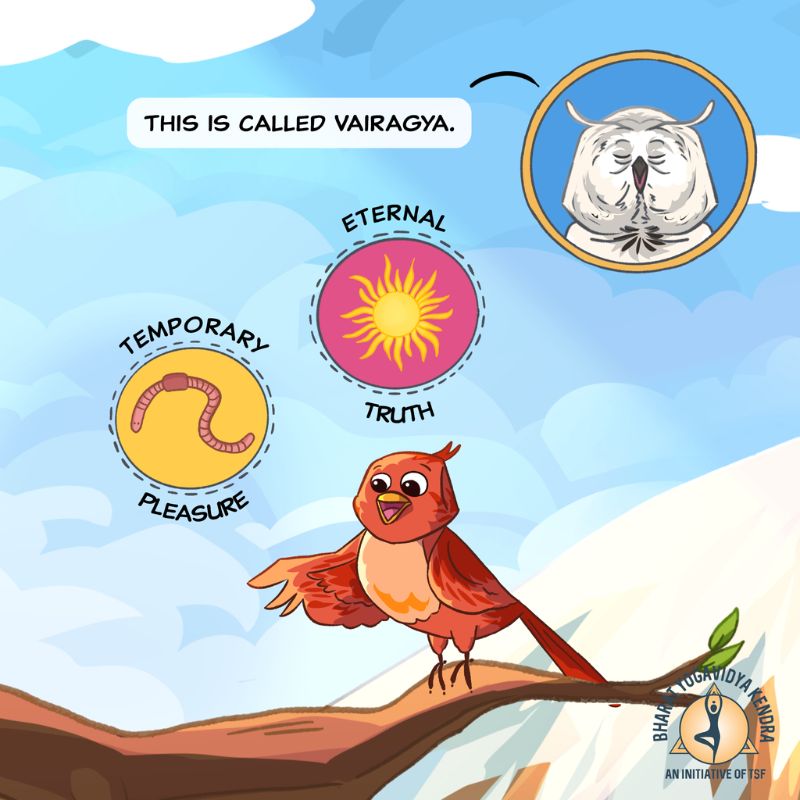
The word “dispassion” often sounds cold, doesn’t it? We mistakenly think it means not loving our families or not enjoying a sunset. But true Vairagya is not indifference; it is independence. It is the capacity to enjoy the world without being crushed when things change—because things always change.
Think of a Trustee of a wealthy estate. A bank trustee manages millions of dollars with great care and precision. They protect it, invest it, and watch it grow. Yet, if the market fluctuates, they don’t lose sleep, because they know, deep down, “This money does not belong to me.” Vairagya invites us to live as trustees of our lives. Love your children, build your career, tend your garden—but hold them lightly, knowing you are a caretaker for the Divine.
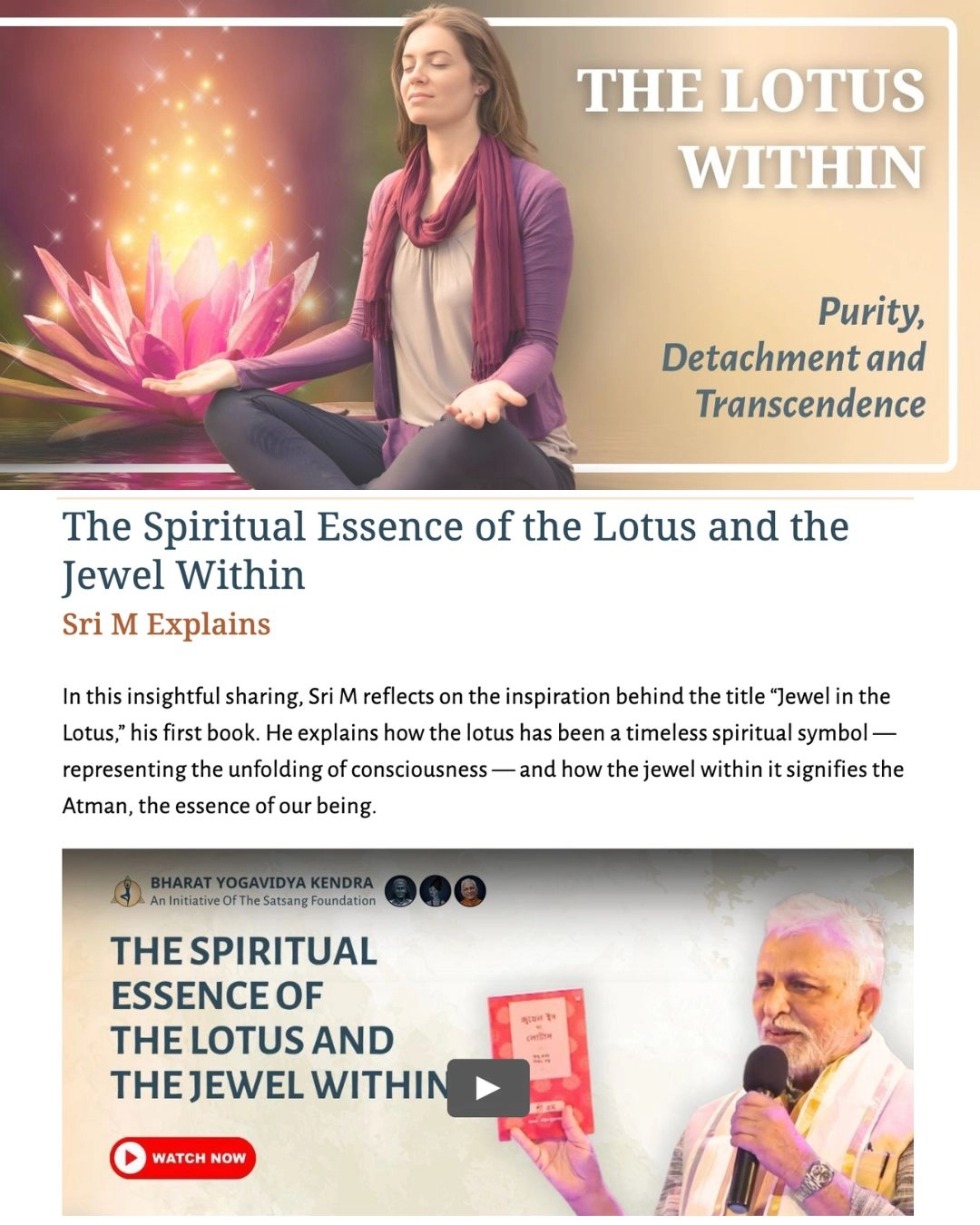
Another beautiful analogy is the Lotus Leaf. It sits in the water, yet the water beads up and rolls off, leaving the leaf dry. Be in the world, but don’t let the world drown you.
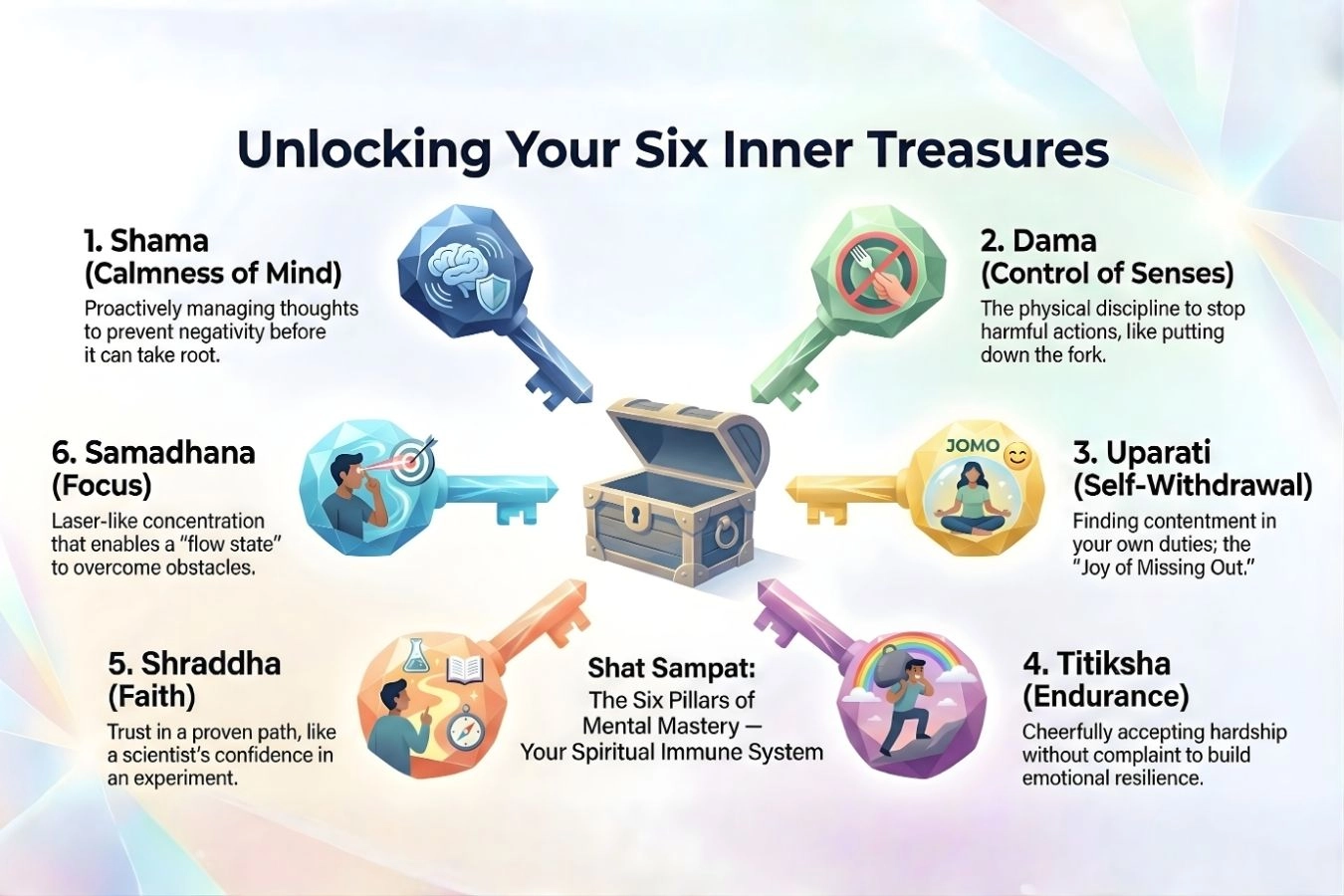
3. Shat Sampat: Your Six Inner Treasures
The third pillar is actually a collection of six mental disciplines. Think of them as your spiritual immune system.
- Shama (Calmness of Mind): This is the driver of the car deciding not to take a dangerous route. It is “Mind Management”—preventing a negative thought before it takes root.
- Dama (Control of Senses): If Shama fails and the car starts rolling, Dama is the brakes. It’s the physical strength to close the laptop, put down the dessert fork, or walk away from an argument.
- Uparati (Self-Withdrawal): In 2026, this is the art of Digital Minimalism. It is finding satiety in your own duty (Svadharma) rather than seeking constant distraction. It is the “Joy of Missing Out” (JOMO) on the noise to focus on the signal.
- Titiksha (Endurance): This is the superpower of resilience. It is bearing the heat, the cold, the traffic jam, and the rude comment without complaining. It isn’t just gritting your teeth; it’s a cheerful acceptance that builds emotional “anti-fragility.”
- Shraddha (Faith): Not blind belief, but the confidence of a scientist running an experiment. It is the trust that the path has been walked by others and will work for you too.
- Samadhana (Focus): The laser-like concentration that burns through obstacles. It is the “flow state” where the dancer becomes the dance, and the worker becomes the work.
4. Mumukshutva: The Hunger for Freedom
Finally, we come to the fuel that drives it all. Mumukshutva is the intense burning desire for liberation. It is the realization that “I want to be free from this cycle of stress and anxiety.”
Imagine a man trapped in a Burning House. He doesn’t stop to play with toys or check his phone. He has one singular focus: Get out. Mumukshutva is the realization that our attachment to the temporary is a burning house, and we must seek the fresh air of freedom. Or think of a hungry man—he doesn’t want a lecture on food; he wants to eat. When this desire for truth wakes up in you, no obstacle can stand in your way.
Building Your Foundation As we step into this New Year, let us not just make resolutions to change our actions. Let us resolve to change our minds. Let us cultivate the clarity of Viveka, the freedom of Vairagya, the wealth of Shat Sampat, and the fire of Mumukshutva.
When the foundation is strong, the house will stand—no matter what the weather brings.
Hari Om Tat Sat.
BOOK REVIEW
Tattva Bodha
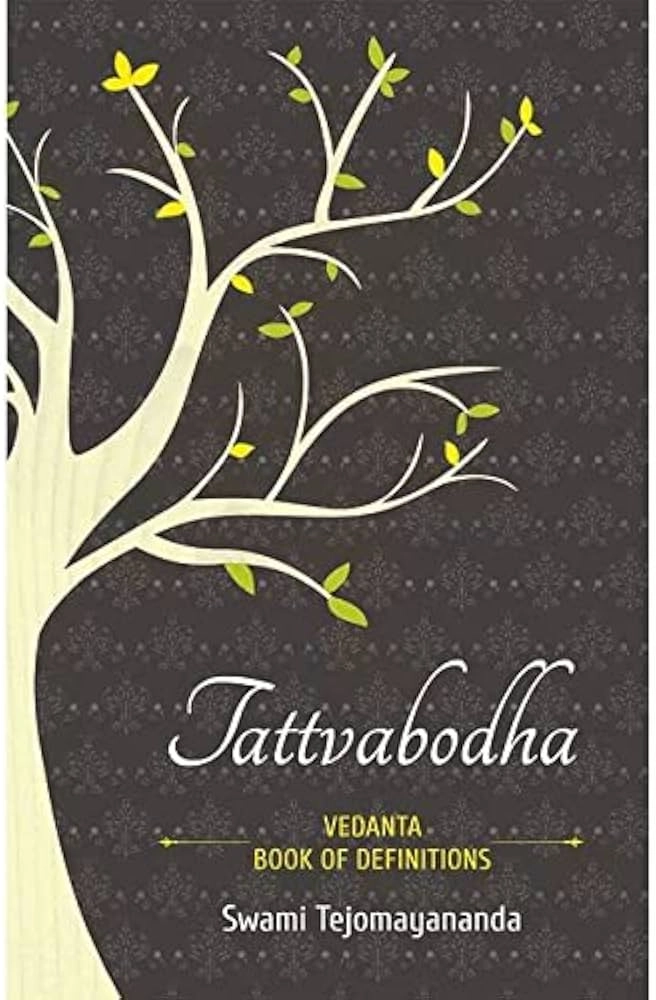
Tattva Bodha is a quiet yet profound doorway into Advaita Vedanta. Attributed to Adi Shankaracharya, this concise text lays the foundation for self-inquiry by clearly defining the essentials of Vedantic knowledge.
What makes Tattva Bodha especially valuable for a seeker is its methodical clarity. It introduces core concepts such as viveka (discrimination), vairagya (dispassion), the 4 fold qualifications of a seeker (Sadhana Chatushtaya), The 6 inner wealth(Shat Sampathi), the nature of the panca koshas, the states of consciousness, the workings of the mind, and the distinction between the atman and the non-self.
For a seeker, this book functions less as a book to be read and more as a mirror for contemplation. It gently but firmly shifts one’s attention from physical practices alone to understanding —from “what I do” to “who I truly am.”
Reading this book slowly under the guidance of a teacher, encourages observation, reflection, and inner inquiry. As a result, yoga practice then begins to feel more integrated—less about physical achievement and more about self-awareness and balance. Written in simple, direct language, Tattva Bodha serves as an ideal book for all seekers to find clarity of understanding and inner freedom.
YOGA GUIDE
Balance – Inner & Outer
Vrikshasana (Tree Pose)

Vrikshasana symbolizes stability, balance, and rootedness—qualities essential for cultivating discernment (Viveka) and dispassion (Vairagya).
Steps to practice Vrikshasana:
- Stand tall with feet together and arms by your side.
- Shift your weight onto the left foot, grounding it firmly.
- Bend your right knee and place the sole of your right foot on the inner thigh of the left leg (avoid the knee joint).
- Bring your hands together in a prayer position (Anjali Mudra) at your chest or raise them overhead with palms joined.
- Fix your gaze on a steady point to enhance concentration.
- Hold the pose for 30 seconds to 1 minute, breathing evenly.
- Slowly release and repeat on the other side.
Benefits:
- Enhances mental focus and clarity (Viveka).
- Develops inner stability and calmness, reducing attachment (Vairagya).
- Builds patience and perseverance, part of Shatsampat.
- Cultivates self-awareness, supporting Mumukshutva.
Pranayama: Nadi Shodhana (Alternate Nostril Breathing)
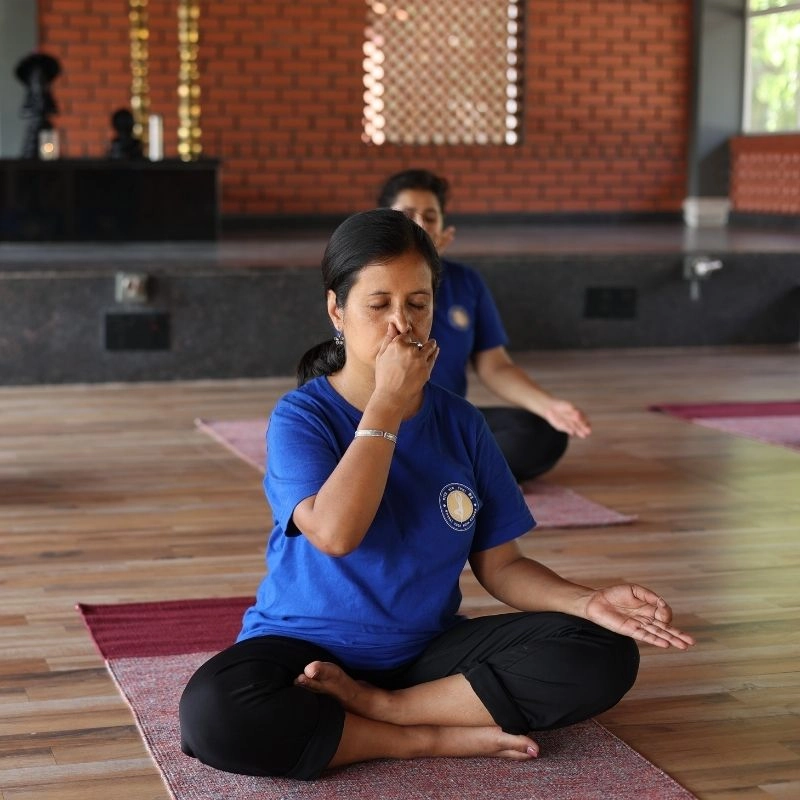
Nadi Shodhana purifies the energy channels (nadis), balancing the mind and emotions, which is crucial for the fourfold discipline.
Steps to practice Nadi Shodhana:
- Sit comfortably with a straight spine.
- Use the right thumb to close the right nostril.
- Inhale slowly and deeply through the left nostril.
- Close the left nostril with the ring finger, release the right nostril.
- Exhale slowly through the right nostril.
- Inhale through the right nostril.
- Close the right nostril again and exhale through the left nostril.
- This completes one cycle. Practice for 5–10 minutes with calm, even breaths.
Benefits:
- Clears mental confusion, enhancing discernment (Viveka).
- Balances emotional fluctuations, aiding dispassion (Vairagya).
- Cultivates calmness and steadiness, enhancing Shatsampat.
- Deepens focus and spiritual yearning (Mumukshutva).
This guide integrates physical balance and breath regulation to support the mental and spiritual qualities of Sadhana Chatushtaya. Regular practice fosters a harmonious state that nurtures the path to self-realization
YOGA RESOURCE
Path to liberation
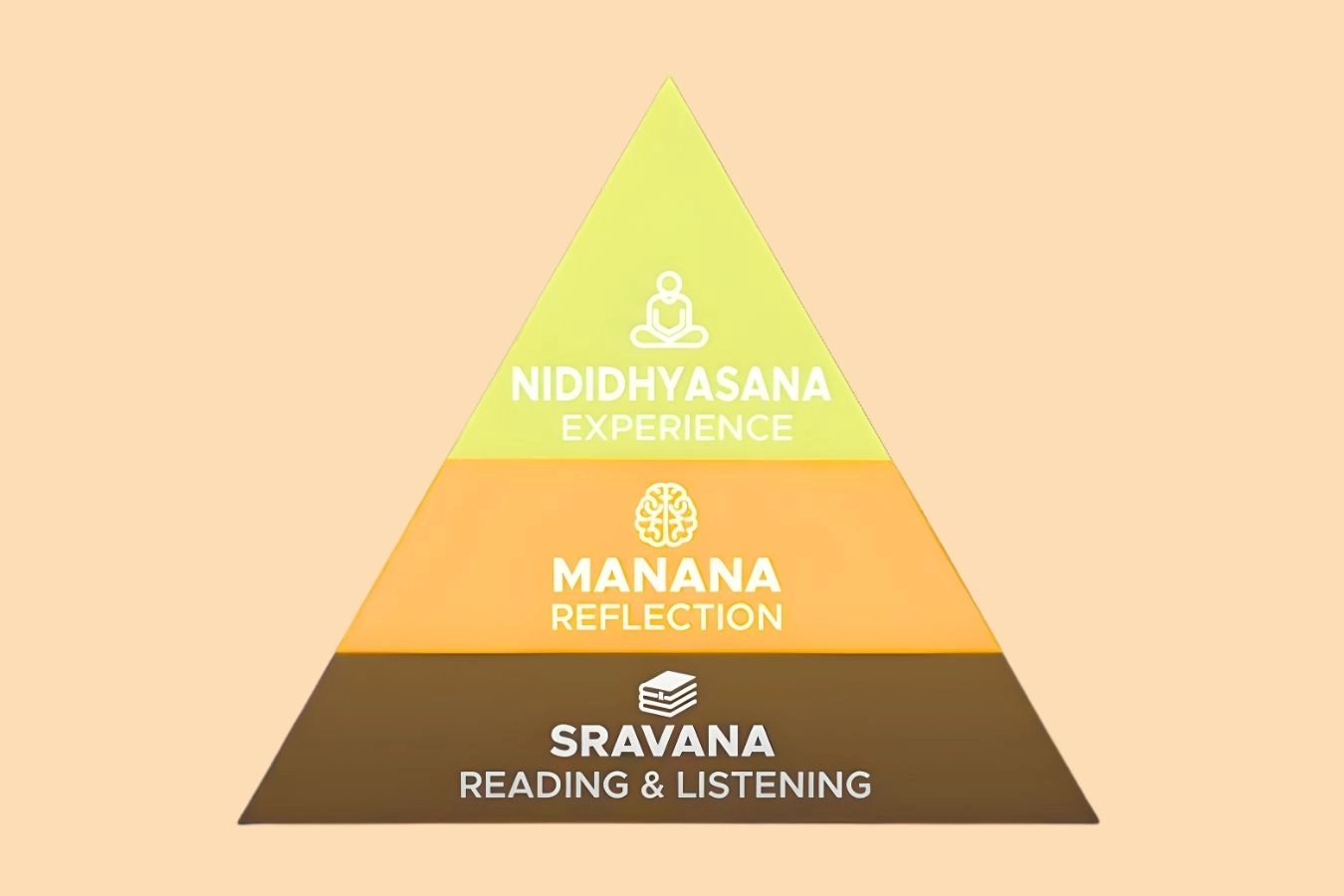
For a seeker and practitioner of Vedanta, Shravanam, Mananam and Nididhyas form an inner discipline that supports steady spiritual growth.
Shravanam is sacred listening. The seeker listens to the words of the Guru, the Shastras, or subtle guidance received during Satsang and svadhayaya, with humility and attention. This listening is not merely with the ears, but with a quiet mind and an open heart.
Mananam is thoughtful contemplation. The seeker reflects on what has been heard, allowing the teaching to settle deeply. Doubts are observed, questioned, and gently resolved through inquiry and self-observation, without haste or struggle.
Nididhyas is deep inner assimilation. Through regular practice-meditation, japa, and mindful living-the seeker abides in the truth understood. The teaching is no longer held only in thought but is lived, gradually transforming perception and conduct.
This journey from listening, to reflection, to steady abidance becomes the bridge between knowledge and inner transformation. In Vedanta, these three together transform knowledge into realization-leading the seeker from intellectual understanding to effortless abidance in the Self.
QUIZ COLUMN
- You are offered a high-paying job that requires unethical practices. Rejecting it because it compromises your peace is an example of:
A) Vairagya
B) Viveka
C) Titiksha
D) Laziness
(Answer: B – Viveka, discrimination between right and wrong/Dharma and Adharma)
- Your internet goes down for 3 hours. Instead of panicking, you use the time to meditate and clean your room. You are practicing:
A) Shama
B) Uparati
C) Mumukshutva
D) Denial
(Answer: B – Uparati, withdrawal from external distractions to focus on duty)
- Which virtue acts as the “brakes” when your senses try to drag you toward an unhealthy desire?
A) Shraddha
B) Dama
C) Samadhana
D) Shama
(Answer: B – Dama, control of the sense organs)
- True Vairagya (Dispassion) is best described as:
A) Hating the world
B) Running away to a cave
C) Participating in life without emotional dependency
D) Ignoring your family
(Answer: C – Being like a lotus leaf in water)
- What is the “Burning House” analogy related to?
A) Anger management
B) Mumukshutva (Urgency for liberation)
C) Home safety
D) Ritual fire
(Answer: B – The realization that Samsara is dangerous and one must seek freedom urgently)
COMMUNITY COLUMN
Sadhana Chatushtaya
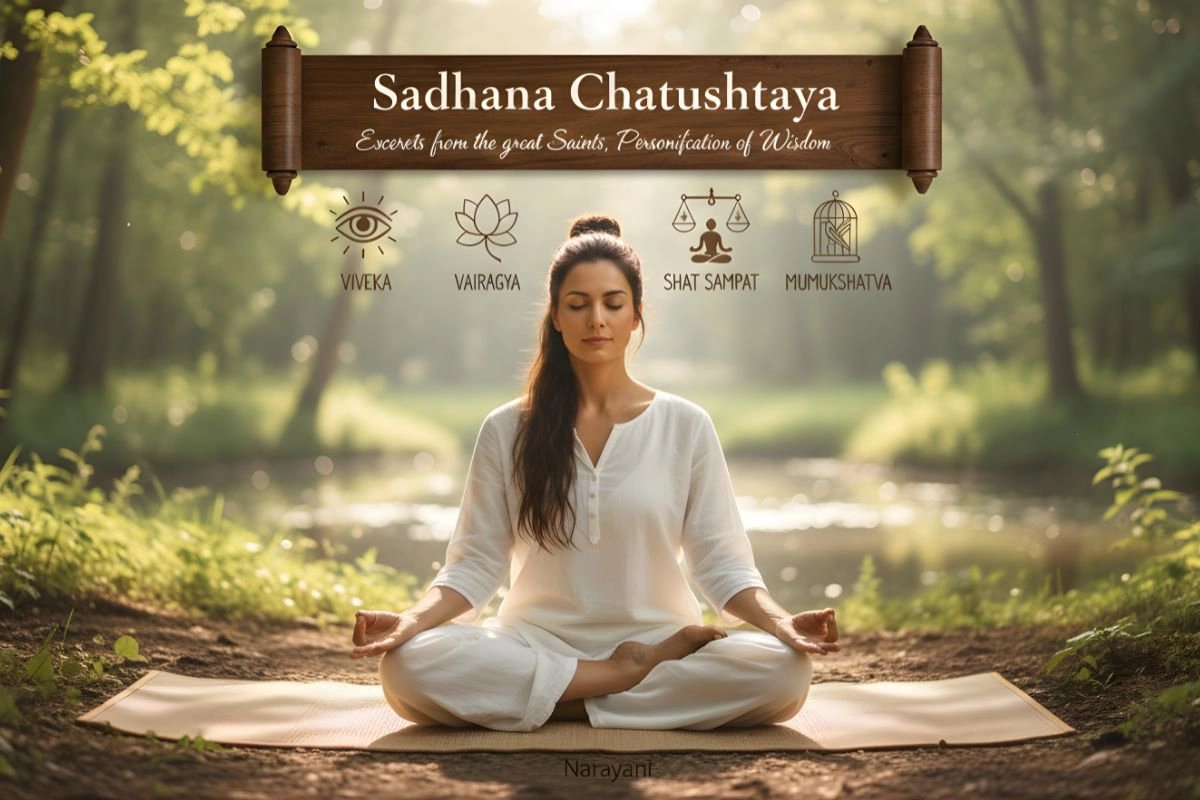
Viveka is discrimination between the permanent and the impermanent. Viveka dawns in a man through the Grace of God. The Grace can come only after one has done unceasing selfless service in countless births with the feeling that he is an instrument of the Lord and that the work is an offering to the Lord. The door to the higher mind is flung open when there is an awakening of discrimination.
There is an eternal, changeless principle amidst the ever-changing phenomena of this vast universe and the fleeting movements and oscillations of the mind.
Association with saints and study of Vedantic literature will infuse discrimination in man. Viveka should be developed to the maximum degree. One should be well established in it.
Vairagya is dispassion or detachment towards that which is not permanent. The Vairagya is result of discrimination between the permanent and the impermanent.
The third requisite is Shad-Sampat, the sixfold virtue. It consists of Sama, Dama, Uparati, Titiksha, Sraddha and Samadhana. All these six qualities are taken as one because they are calculated to bring about mental control and discipline, without which concentration and meditation are impossible.
Sama is control over mind. When one has detachment towards impermanent, one gets control over mind. Because mind is always caught up in finding happiness in impermanent things.
Dama is rational control of the senses. If one has control over mind, control over senses is obvious result.
Uparati is ones ability to perform his daily duties without skipping and sitting quiet in silence in his free time, knowing well that indulging in impermanent leads to suffering and sitting quiet in silence lead to ultimate liberation. Uparati is result of Sama and Dama.
Titiksha is ones ability to bear pain in extreme situations. As result of Sama, Dama and Uparati, individual has lot of energy to face with extreme situations and even extreme situations like pain and pleasure are treated as same.
Sraddha is intense faith in the word of the Guru, in Vedantic scriptures and, above all, in one’s own self. It is not blind faith but is based on accurate reasoning, evidence and experience. As such, it is lasting, perfect and unshakable. Such a faith is capable of achieving anything. These experiences are result of Sama, Dama, Uparati and Titiksha.
Samadhana is fixing the mind on Brahman or the Self, without allowing it to run towards objects. The mind is free from anxiety amid pains and troubles. There is stability, mental poise and indifference amid pleasures. The aspirant has neither like nor dislikes. He has great inner strength and enjoys unruffled peace of mind, due to the practices of Sama, Dama, Uparati, Titiksha and Sraddha.
Mumukshutva is intense desire for liberation or deliverance from the wheel of births and deaths with its concomitant evils of old age, disease, delusion and sorrow. If one is equipped with the previous three qualifications (Viveka, Vairagya and Shad-Sampat), then the intense desire for liberation will come without any difficulty. The mind moves towards the Source of its own accord when it has lost its charm for external objects. When purification of mind and mental discipline are achieved, the longing for liberation dawns by itself.
Ayurvedic Wisdom

Sadhana Chatushtaya and its relevance through ayurvedic lens.
In Ayurveda, Viveka (discrimination or discernment) is crucial for well-being, primarily through the ability to differentiate between what is wholesome (sattvic) and unwholesome for the body and mind, and ultimately, between the real and the unreal.
Ahara Viveka (discrimination of food). Dietary Discrimination This capacity guides lifestyle choices, diet, and therapeutic practices to maintain or restore balance.
Viveka is the mental faculty that helps an individual understand their unique constitution (Prakriti) and current imbalances (Vikriti) This allows for making informed decisions about diet, lifestyle, and therapies that are specifically suited to their needs.
Mind-Body Connection: Ayurveda emphasizes that the mind (Manas) and body are deeply interconnected. A disturbed mind is often seen as a root cause of disease. Cultivating Viveka purifies the mind, which in turn supports the health of bodily tissues (Dhatus) and overall well-being.
Preventive Care (Swasthavritta): By using Viveka, individuals can make daily choices that prevent illness. For example, waking up during Brahma Muhurta (early morning) is recommended in Ayurveda because the environment at that time is calm and pure, fostering mental clarity and better health outcomes, a choice guided by Viveka.
Therapeutic Decisions (Chikitsa): For an Ayurvedic practitioner, Viveka is vital for correct diagnosis and treatment planning. It involves the critical judgment to select appropriate herbs; determine the right dosage, and choose procedures like Panchakarma (detoxification therapy) based on a patient’s specific condition and constitution (Koshta).
In Ayurveda, the concept of Vairagya (detachment or dispassion) is relevant primarily as a psychological and spiritual foundation for health, rather than a direct medical treatment. Vairagya contributes to this holistic health in several key ways:
Stress Reduction and Mental Balance Vairagya helps mitigate the stressors by fostering a detached mindset, leading to a calmer, more fulfilled, and happier mental state.
Preventing Lifestyle Disorders: it is recognized that the fast-paced, attachment-driven lifestyle of the contemporary world contributes to various “lifestyle disorders”. Cultivating vairagya helps individuals cope with daily pressures and prevents the mental agitation that leads to such imbalances.
Supporting Yogic Practices For controlling the fluctuations of the mind (chitta vritti nirodha). A calm and controlled mind is more receptive to the healing and balancing effects of Ayurvedic treatments, diet, and lifestyle recommendations.
In essence, while vairagya is a spiritual concept aimed at achieving liberation (moksha), in the practical application of Ayurveda, it serves as a powerful psychological tool. It helps establish the necessary mental environment of peace and non-attachment, which is a prerequisite for the body and mind to achieve and maintain their natural state of balance and health (homeostasis).
True vairagya is seen as an internal mental disposition that can be practiced by anyone, regardless of their external life circumstances.
TESTIMONIALS
Digital Detox & Inner Recharge
At the outset i want to congratulate and thank BYK team for a thought fully planned detox program. Especially Chitra Madam and Vijayendra Sir .
The fact that I am writing a feedback so late shows how effective the Detox program was.
Jokes apart I really appreciate the warmth and informal interactions we had with our instructors. Must say for the first time, I thoroughly enjoyed the yoga sessions; I’m not really sure why and can’t quite put my finger on any one specific reason.
Chitra madam’s in depth knowledge and Vijayendra sir’s unmatched energy, passion and enthusiasm to share what he knows, sir u truly are an asset to the field of Yoga.
Be it the discussion on Ashtanga Yoga, Pranayama and Yoga Nidra sessions, Eye exercises, Trataka session and off course how can I forget the Painting session which took me back to my school days .
Every thing was well thought of , very rewarding as well.
I think it was a true embodiment of Sir’s Teachings, it was a true experience of the mantra “SAHANAVAVATU” it was soo grounded friendly and informal.
Thank You, Team BYK
– Kumaraswamy B N
Upcoming Courses & Retreats
![Logo of Bharat Yogavidya Kendra [BYK]](https://bharatyogavidyakendra.in/wp-content/uploads/2025/07/BYK-Logo-300px.png "BYK-Logo-300px")
Thank you for reading