
Have you ever noticed how the mind has a life of its own? You sit down to meditate and within seconds it has wandered off to a conversation from last week, a worry about tomorrow, a song you heard in the car. You did not invite any of it. It just showed up.
Vedanta says this is because the mind is not one thing. It is four. Manas receives and churns. Buddhi is supposed to decide, but often it is asleep. Ahamkara — the sense of “I” — claims everything that passes through. And chitta stores it all, replaying old patterns whether we want them or not. Most of the time, these four run the house while we think we are in charge.
This month we look at this honestly. Not to feel bad about it, but because seeing clearly is where change begins. Sir always brings it back to practice: sit, watch, do not argue with what you see. When you stop stirring the water, it clears on its own. You do not have to force anything.
Refinement is not about becoming somebody new. It is about noticing what has been running in the background all along, and gently, steadily, choosing not to be pushed around by it. The articles, reflections, and practices in this issue are here to help with that noticing.
Read slowly. Sit with what stays with you.
Om Tat Sat.
Cognitive Distillation through Vedantic Inquiry
Sri M Explains
Talk with M



BLOG POST
Evolving the Mindset via Non-dual Philosophy
Most of us assume we have one mind. We say “my mind is restless” or “my mind won’t stop” as if there is a single thing in there making all the trouble. But Vedanta looked more carefully than that, a long time ago, and said — actually, it is not one. There are four functions at work, and until you see them separately, you will keep blaming “the mind” without knowing what you are blaming.
Let us look at them one by one.
The first is **manas**. Manas is the part that receives. A sound comes, a sight comes, a memory floats up, and manas starts to churn. Is this good? Is this bad? Should I worry about this? It is like a gatekeeper who lets everyone in and then panics about the crowd. On its own, manas has no ability to decide. It just keeps turning things over. If you have ever lain awake at night going round and round on the same thought without reaching any conclusion, that is manas running on its own with nobody to guide it.

The second is **buddhi**. Buddhi is supposed to be the one who decides. When manas brings something forward, buddhi should say — yes, this is worth your attention, or no, let this go. Think of buddhi as the elder in the house. When the elder is alert, there is order. But the problem is that buddhi often goes to sleep, or worse, it starts working for the ego. We have all done this — built a perfectly logical argument for something we wanted to do anyway. That is buddhi being hired by the wrong employer.
In our tradition, Sir often says that meditation is what wakes buddhi up. You do not sharpen discernment by reading more books about discernment. You sharpen it by sitting still. When the noise settles, buddhi begins to function on its own, the way water becomes clear when you stop stirring it. There is nothing to force. You just have to stop disturbing.
The third is **ahamkara**. This is the one that says “I” and “mine.” My achievement. My insult. My family. My opinion. Now, without some sense of “I,” you cannot function at all. You cannot eat breakfast or cross the road. The trouble is not that ahamkara exists. The trouble is that it grows without limit and starts to believe it is the whole person. It takes every passing experience and stamps ownership on it. Then when something threatens what it has claimed — my position, my image, my comfort — it reacts, and suddenly we are in conflict, inside and outside.
Advaita Vedanta says something very direct about this. The Self is not the ego. The ego is a function, a kind of working fiction. It is useful, like a name tag at a conference — it helps you navigate. But you are not the name tag. In meditation, when you watch a thought arise and then dissolve, you notice that the one watching did not dissolve with it. That small noticing, if you stay with it, begins to loosen ahamkara’s grip. Not by fighting it, but simply by seeing through it. This is something one has to experience for oneself. No amount of reading about it will do the work.
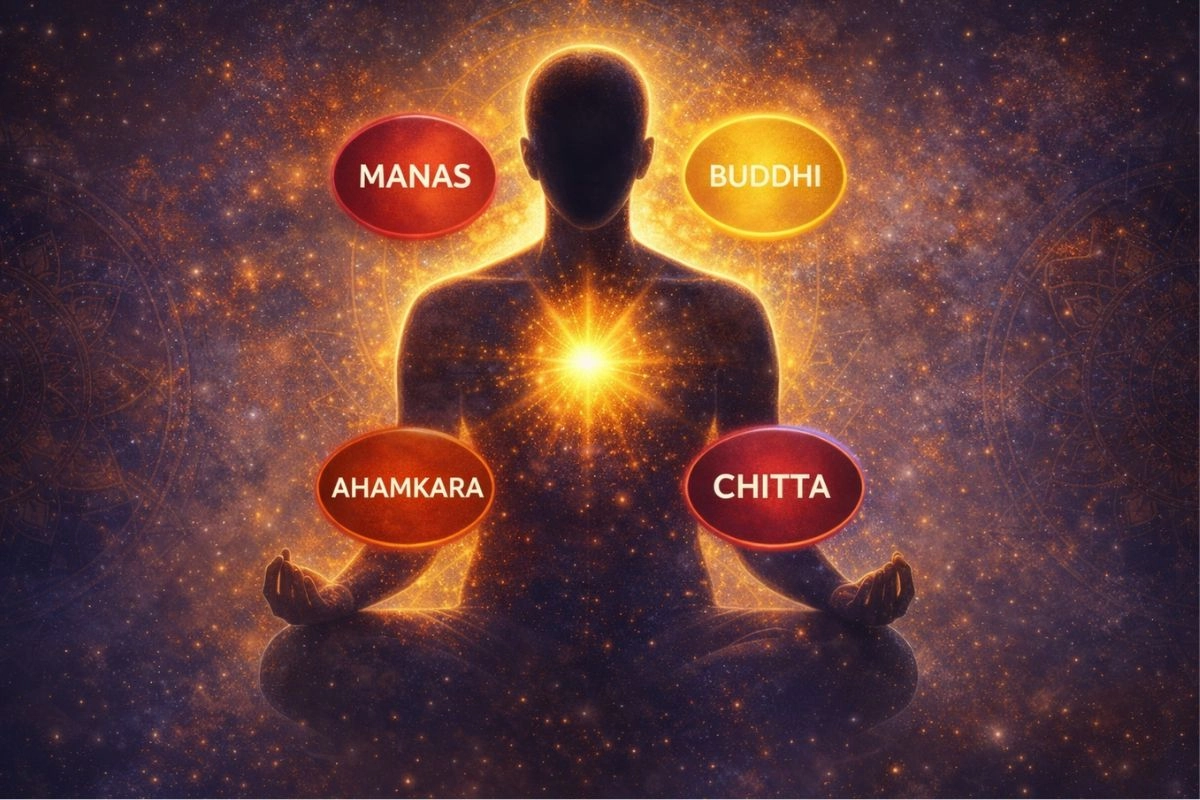
The fourth is **chitta**. Chitta is the storehouse. Every impression, every memory, every tendency you have carried — chitta holds it all. It is the reason a particular tone of voice can upset you even when the words are harmless. It is the reason you are drawn to certain things and repelled by others, often without knowing why. These are old recordings, playing in the background.
We cannot wipe chitta clean. That is not how it works. But we can change what we are feeding it. When we sit honestly in meditation, that goes into chitta. When we catch ourselves reacting and pause instead, that goes in too. A small act of kindness done without needing anything back — that also leaves an impression. Over time, the old recordings lose their volume. The newer impressions begin to set the tone. Sir has compared this to sweeping a room. You do not need to study each grain of dust. You sweep every day and the room stays clean.
Now, behind all four of these — behind the churning, the deciding, the claiming, the storing — Vedanta says there is something else. The witness. Sakshi. It does not churn, it does not decide, it does not claim, it does not remember. It is simply aware. When the four instruments quiet down, even for a few seconds, this witness is not created or achieved. It is recognized. It was there the whole time. We just could not hear it over the noise.
This is what the tradition means by refinement of the mind. It does not mean making the mind clever or filling it with more knowledge. It means seeing clearly what the mind actually is — an instrument, not the master. And behind the instrument, the one who was always watching.
So how does this work in practice? Sit daily. Even if the mind wanders, sit. Watch what manas is doing without getting involved. Let buddhi wake up in its own time. Notice when ahamkara inflates, and instead of scolding it, just see it. Let chitta do its replaying, and do not get pulled in. Over weeks and months, something shifts — not dramatically, not with fireworks, but like the slow clearing of a sky after rain.
And alongside the sitting, examine your day. How did I behave? Where did I react when I could have paused? Where was I completely occupied with myself when I could have looked at someone else? Both of these together — the sitting and the self-examination — are sadhana. One without the other is incomplete.
The mind is a good servant and a terrible master. Vedanta and our Nath tradition both agree on this. Refine the instrument, and it serves you. Leave it unattended, and it will run your life in circles. The choice, as always, is ours.
Om Tat Sat.
BOOK REVIEW
Vivekachudamani by Swami Turiyananda

Vivekachudamani, the crest jewel of discrimination, traditionally attributed to Adi Shankaracharya, is one of the most profound texts guiding a sincere seeker toward Self-knowledge. For any sadhaka, this book feels especially relevant because it brings clarity to the deeper purpose of all practices.
While many approach yoga through the body and breath, this book gently reminds us that the ultimate aim of all sadhana is the recognition of the Self. The text beautifully explains viveka (discrimination between the real and the unreal) and vairagya (dispassion), qualities that every practitioner gradually cultivates through practice, discipline, and reflection.
What resonates deeply for me is how the text emphasizes the preparedness of the student—the sadhana chatushtaya: discrimination, dispassion, the six inner virtues, and an intense longing for liberation. These qualities mirror the inner transformation that yoga practice seeks to nurture beyond the mat.
As a teacher and student of Yoga, reading Vivekachudamani expands the context of yoga. It reminds us that asana, pranayama, and meditation are not ends in themselves but part of a larger journey toward clarity, stillness, and self-inquiry. The dialogue between guru and disciple also highlights the importance of guidance, humility, and sincere questioning on the spiritual path.
For yoga practitioners and sadhakas alike, this book serves as a powerful companion text—one that continually redirects attention from external practice to inner wisdom. It is not just philosophy to be studied, but a mirror that invites the seeker to look within and discover the truth of one’s own nature.
YOGA GUIDE
Refinement of the Mind through Advaita Vedanta
The refinement of the mind through Advaita Vedanta involves deep self-inquiry and understanding the subtle faculties of the mind—Manas (deliberation), Buddhi (decision), Ahamkara (ego), and Chitta (memory). These components influence how we perceive reality and progress spiritually. A yoga practice aligned with this theme should calm the mind, enhance clarity, and support self-awareness, facilitating the dissolution of ego and strengthening discernment.
Understanding the Mind’s Components in Spiritual Progress
- Manas (Deliberation): The mind that processes sensory inputs and contemplates options. It can create distractions or doubts.
- Buddhi (Decision): The faculty of intellect that discriminates and makes choices, crucial for discerning truth from illusion.
- Ahamkara (Ego): The sense of “I”-ness or individuality, often the root of attachment and suffering.
- Chitta (Memory): The storehouse of impressions and past experiences influencing present thoughts and behavior.
Refining these faculties through yoga helps dissolve false identification with ego and reveals the non-dual Self, the core teaching of Advaita Vedanta.
Recommended Practice
Yoga Asana: Vrikshasana (Tree Pose)

Why: Vrikshasana cultivates balance, focus, and steadiness—qualities essential for mastering Manas and Buddhi. It encourages inward concentration and grounding, reducing mental agitation.
How to practice:
- Stand tall with feet together, arms relaxed by the sides.
- Shift weight onto the left foot, grounding it firmly.
- Place the sole of the right foot on the inner left thigh or calf (avoid the knee).
- Bring hands to prayer position (Anjali Mudra) at the heart center or raise them overhead.
- Fix your gaze on a steady point (Drishti) to improve concentration.
- Hold for 30 seconds to 1 minute, breathing evenly.
- Switch sides and repeat.
Pranayama: Nadi Shodhana (Alternate Nostril Breathing)

Why: Nadi Shodhana purifies the subtle energy channels (nadis), balances the nervous system, and calms the fluctuations of Manas and Chitta. It enhances clarity in Buddhi and reduces the grip of Ahamkara by promoting inner harmony.
How to practice:
- Sit comfortably with a straight spine.
- Use the right thumb to close the right nostril.
- Inhale slowly and deeply through the left nostril.
- Close the left nostril with the ring finger, release the right nostril.
- Exhale slowly through the right nostril.
- Inhale through the right nostril.
- Close the right nostril again and exhale through the left nostril.
- This completes one round.
- Practice for 5–10 minutes, maintaining slow, smooth breaths.
This combined practice of Vrikshasana and Nadi Shodhana supports mental refinement by stabilizing the mind, enhancing discrimination, and quieting egoic tendencies. Regular practice cultivates the inner stillness and clarity essential for the Advaitic realization of the Self beyond mind fluctuations.
YOGA RESOURCE
Sharpening Mental Clarity through Advaita

The refinement of the mind in Advaita Vedanta is not merely an intellectual exercise but a systematic process of stripping away the “superimpositions” (upadhis) that cloud our true nature. In this tradition, the mind is viewed as a mirror; when covered in the dust of desires and distractions, it cannot reflect the light of the Self (Atman).
The Concept of Antahkarana Suddhi
The primary goal is Antahkarana Suddhi, or the purification of the internal instrument (the mind, intellect, ego, and memory). Advaita teaches that the mind itself is a flow of thoughts (vrittis). Refinement involves transitioning the mind from a state of Rajas (agitation) and Tamas (inertia) toward Sattva (lucidity and balance).
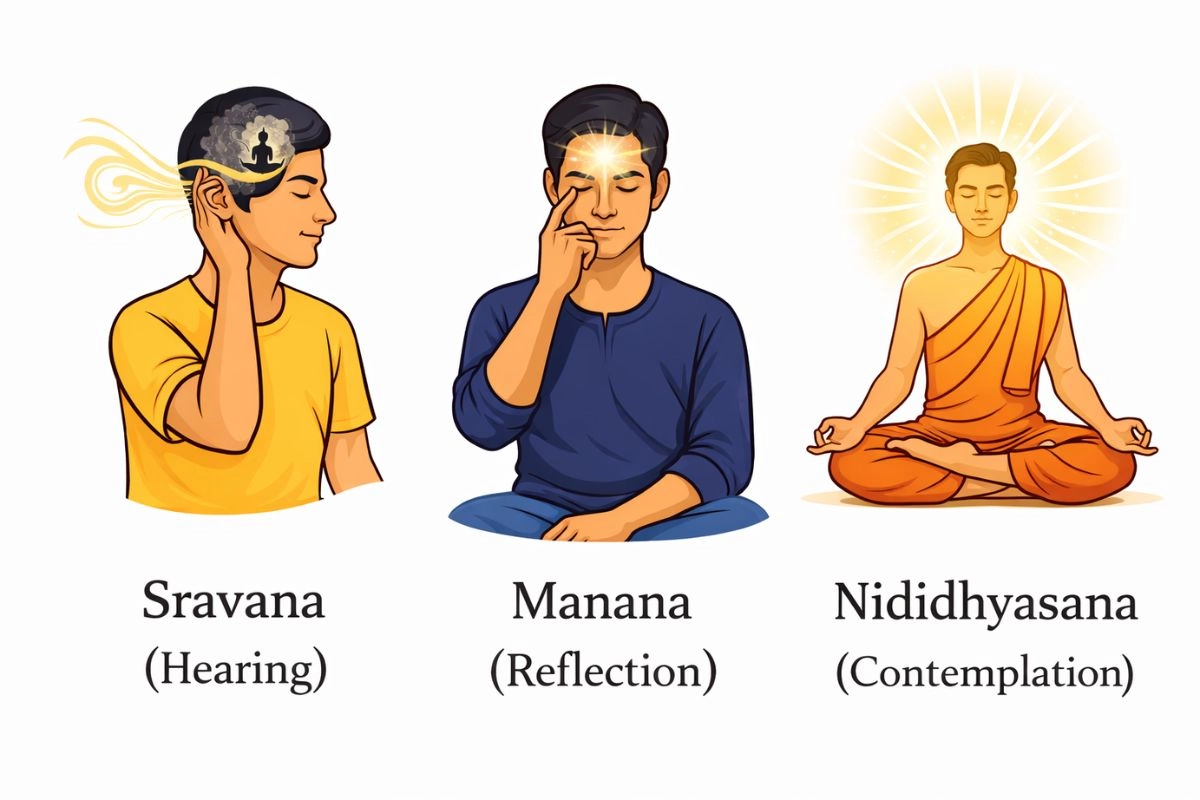
The Three-Step Process of Refinement
- Sravana (Hearing): Listening to the non-dual truths, which plants the seed of refinement by challenging the ego’s narrative of separation.
- Manana (Reflection): Rigorous intellectual analysis to remove doubts. The mind is refined by constantly questioning the “I” thought.
- Nididhyasana (Contemplation): Deep internalizing of the truth where the refined mind becomes so still that it eventually dissolves into the Self.
Perspectives from Spiritual Leaders
Ramana Maharshi
While Maharshi taught the direct path of Atma-Vichara (Self-Inquiry), he viewed the refinement of the mind as the process of tracing the mind back to its source.
“The mind is nothing but a bundle of thoughts. The first of all thoughts is the ‘I-thought.’ When you investigate where this ‘I’ arises, the mind subsides.”
For Maharshi, refinement wasn’t about making the mind “better,” but making it so thin and transparent that it ceases to exist as a separate entity.
Swami Vivekananda
Vivekananda brought a practical, “Vedantic Psychology” approach to the topic. He believed that the refinement of the mind was a precursor to any real social or spiritual progress.
“The mind is like a lake. Every thought is a ripple. To see the bottom (the Atman), the surface must be perfectly calm.”
He emphasized that Karma Yoga (selfless action) is the most effective tool for the modern person to scrub the mind of egoistic tendencies.
Sarvepalli Radhakrishnan
The philosopher-statesman interpreted Advaitic refinement as an evolution of consciousness. He suggested that the refined mind is one that has moved from “intellectual knowledge” to “intuitive experience.” He noted that the mind must be trained to look past the “multiplicity” of the world to find the “underlying unity.”
Adi Shankaracharya
The primary architect of Advaita Vedanta emphasized that the mind is the cause of both bondage and liberation. In his work Vivekachudamani, he notes:
“A mind free from attachment to sense-objects becomes pure. Therefore, the wise man should first practice detachment… to achieve the purification of the mind.”
He argued that a refined mind is like a “lamp in a windless place,” steady and unwavering in its focus on Brahman.
COMMUNITY SECTION
Dissolving the Ego in the Ocean of Non-duality
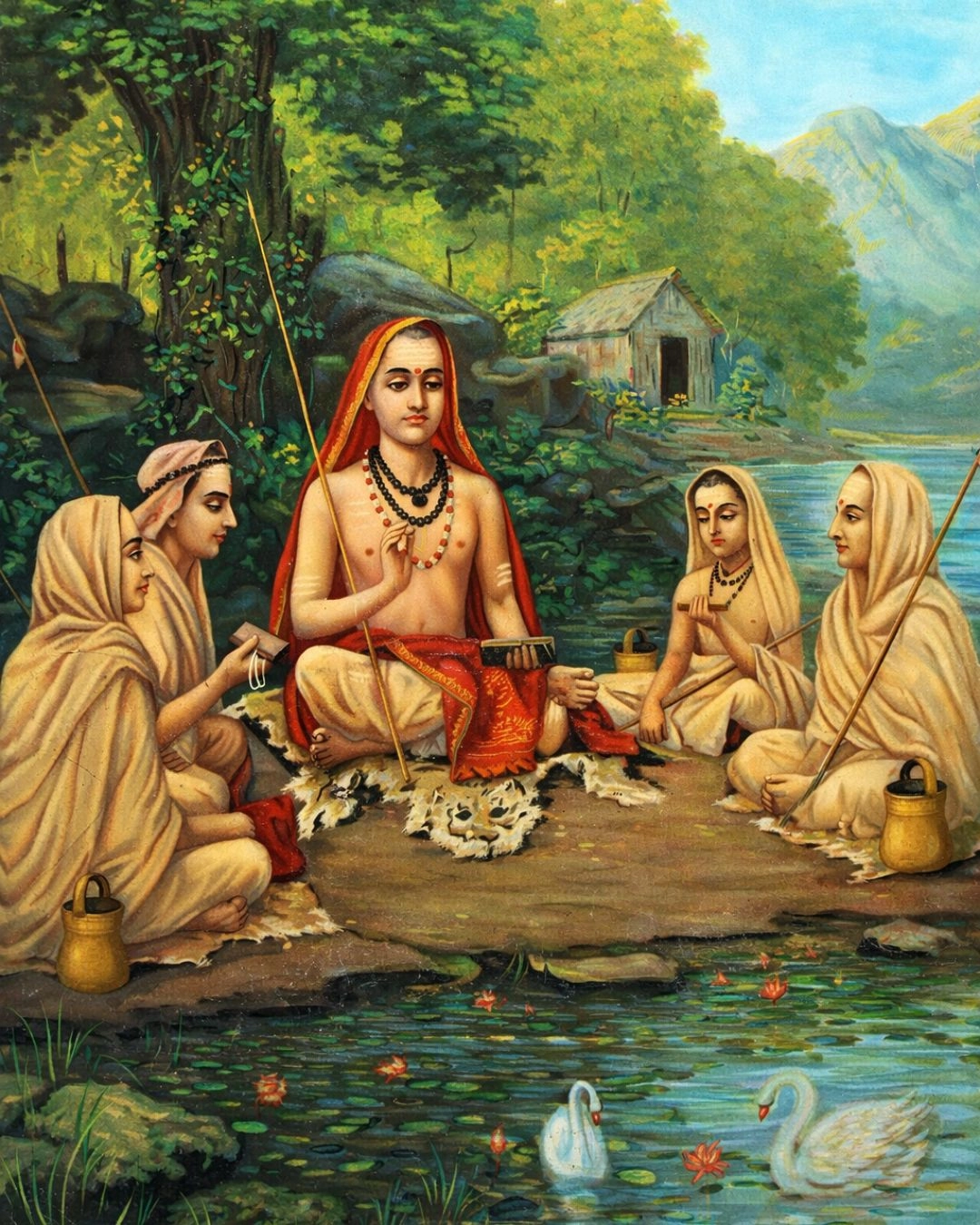
According to Adi Shankaracharya, the founder of Advaita Vedanta, the mind (Manas) is not an independent conscious entity but an “internal instrument” (Antahkarana) that is part of the subtle body, created from the subtle essence of food. It is considered a material entity that appears sentient only because it reflects the light of the true Self (Atman).
Shankara defines the mind in the context of its fourfold functioning (antahkarana-chatushtaya) as follows:
- Manas (Processing Mind): The aspect that handl doubting, willing, and processing sensory input.
- Buddhi (Intellect): The discriminative, deciding, and judging faculesty.
- Chitta (Memory/Subconscious): The storehouse of memories and past impressions (samskaras).
- Ahamkara (Ego): The self-arrogating principle that identifies with the body (“I”- maker).
Key Aspects of Manas per Shankaracharya:
- Dual Nature (Sankalpa-Vikalpa): Manas is defined as the doubting or willing faculty, constantly fluctuating between alternatives, such as “should I do this” or “should I not do this”.
- Instrument of Knowledge: Manas is the essential tool for perceiving the external world through the sense organs. It takes the impressions from the senses and presents them to the intellect (buddhi).
- Cause of Bondage and Liberation: Shankaracharya emphasizes that when the mind is attached to objects of desire, it leads to bondage, but when it is purified and detached, it leads to liberation.
- Not the Self: In his Nirvana Shatakam, Shankaracharya clearly states: “Mano buddhy-ahankara chittani naham”—I am not the mind, intellect, ego, or memory. It is a modification of matter, not the pure consciousness (Atman).
- Subtle Substance: The mind is composed of the finest part of consumed food.
In summary, for Shankaracharya, the Manas is a transient, material, and changing instrument that, when controlled and directed toward the Self, becomes the means to achieve the ultimate knowledge of Non-duality (Advaita).
Functional Unity: In Tattvabodha, Shankara describes these as part of the Antahkarana, where Manas corresponds to the throat, Ahamkara to the heart, and Chitta to the navel.
Goal: The goal is not merely controlling the manas, but dissolving the ahamkara and calming the chitta to realize the underlying Brahman.
According to Lord Krishna in the Bhagavad Gita, Manas (mind) is the lower, restless instrument that acts as either the best friend or worst enemy, depending on whether it is controlled. It functions as the sensory processor— collecting impressions, thinking, feeling, and willing—and is fundamentally attached to the material world.
Restless and Unstable: Krishna acknowledges that the mind is notoriously difficult to curb, restless, and strong.
Material Orientation: By default, it projects outward toward Maya (material world) and needs to be directed inward.
Krishna advises that while difficult, the mind can be controlled through constant practice and dispassion.
Bridling Senses: It must be brought back from its wanderings to focus on the Self.
DEAD MIND: Ramana Maharshi emphasized mruta manas (dead mind), which is a mind devoid of thoughts and ego, turned completely inward to the Atman.
SUDDHA MIND: The “pure mind” or suddha manas is the state of a Jnani (liberated soul), which is identical to the Self, whereas the ordinary mind is ashuddha (impure) due to selfish desires.
Key Aspects of the Mind according to Sri M:
- Definition: Mind is simply a flow of thoughts. When thoughts stop completely, the mind ceases to exist in its ordinary sense.
- Nature: Thoughts are restless and vibrating, moving between past, present, and future.
- Function: It often operates through language.
- The Goal:The aim is to move from a restless mind to a “quiet mind” or “no mind” state, which allows one to experience the underlying consciousness.
- Management: A positive state of mind is crucial, which can be achieved through techniques like chanting Om, fixing attention, and serving others.
JOURNEY OF A SATSANGI
Journey of a Satsangis – Part 2: 1st Impressions of India

Hello again! Last month I began the story about my journey to become a Satsangis. If you missed it and are interested, please check it out in the February edition of the BYK Newsletter – link below:
As mentioned in the previous episode, I learned about Sri M from a gentleman I met on the plane named Prabs. I did not know anything about Sri M at the time and since I was on my way to the spiritual center to look for volunteering opportunities at a spiritual foundation there, I continued on my journey.
The moment I landed in India, I knew I was very far from the world I had grown up in in Canada. Some differences made themselves known immediately—like how hot it was even in late November/early December. There was also the fact that everyone drives on the left instead of the right. The buildings and homes in India also seemed to celebrate every shade imaginable, a contrast to the more conservative, muted palette I was used to back in Canada.
And there were animals everywhere! I was fascinated to see packs of monkeys (my first time seeing monkeys outside of a zoo) on the side of the road and to see cows strolling calmly down busy city streets as traffic simply flowed around them. No outrage, no dramatic scenes—just a collective understanding that the cow would set the pace, and everyone else would adjust accordingly. There were even people transporting their goats – on a motorcycle!
Beyond the obvious differences, it was often the small details that truly made it sink in that I was somewhere new. I’ve always felt that the little things often tell a bigger story than the big ones. In India, for example, a light switch is on when it’s flipped downward, rather than upward like in Canada. In the bathroom, instead of a shower there was a bucket—something that took me a little time to get used to when it came to bathing. Even the way floors are numbered was different: a building has a ground floor, and the first floor is one level up, whereas in Canada the ground floor is the first floor.
The language people used around certain topics was also subtly different. In Canada, we have “food” and “vegetarian food,” while in India, there is “non-veg food” and simply “food” for what we would call vegetarian food. Small differences like these quietly reminded me that I was learning the rhythms of a new culture.
As I took in all the differences, both big and small, there was a moment when I felt completely overwhelmed and began to question my decision to come to India. Had I made the right choice? Would I be able to adjust to the people, the food, the climate, and everything else that felt so unfamiliar? What steadied me in that moment was remembering the promise I had made to myself—to simply accept whatever came my way and to enjoy the process of discovering a new place, its people, its food, and its way of life. Learning to embrace the journey helped me see these differences as moments to appreciate rather than something to fear or dread. As I gradually learned to accept the reality of my journey, it began to feel as though an invisible hand was gently guiding me to where I needed to be. It wasn’t until much later that I learned that accepting reality is a very large and integral part of spirituality.
I did not know any Indian languages or dialects and my only spoken language was English but this didn’t become too much of an issue since, wherever I went, there was always a helpful person who knew enough English that happily translated for me. I found the people to be very direct and honest and most of the people I met were just happy at the novelty of conversing with a foreigner.
Outside of my hotel was always a busy congregation of street vendors on the sidewalks. That’s another thing about India, in a lot of places outside of the big cities, either there are no sidewalks or the sidewalks are full of street vendors so pedestrians mostly walk on the side of the street.

It was at a street dosa vendor (to this day the one of best dosa I’ve ever eaten) that I met a law student by the name of Raghul. Raghul was from a nearby farming village and was being supported by his parents to study law. Raghul became my unofficial tour guide during my stay and he was super helpful in getting my bearings and we even ended up going on a train trip to Tirupati together (more about this later). I learned so much about the city and India in general through my talks with Raghul.
He gave me a local perspective about the spiritual center and told me that while the center was beautiful, it was mostly meant for foreigners as it was too expensive for the local people. When we got to the spiritual center (about 1hr drive from my hotel), I quickly agreed. The place was stunningly beautiful but most of the shops around the center had very “Western” pricing. For instance, a cup of Chai was Rs.250 (around $3.50 USD). To put this into perspective, the dosa at the vendor outside of my hotel (which came on a large banana leaf with 3 different chutneys) was RS.10. Raghul even had a deal with the dosa vendor to pay Rs.600 for all-you-can-eat dosa at his stall for a whole month!! Raghul ate dosa at the vendor for breakfast and dinner every day to keep the costs of his food down for his parents while attending school. Rs.600 for a whole month of meals was astounding to me since I typically spent more than that for 1 meal in Canada.
After making a couple of trips to this spiritual center and not making much progress, along with what I learned from Raghul and some other locals, I started to feel that this spiritual center was not the right place for me. I sat in my hotel room unsure what I should do next. It was then that I remembered my conversation with Prabs on my plane ride. What was the name of that spiritual master again? Right, his name was Sri M.
On a whim, I checked out Diane’s (my wife’s) kindle since she had a large repository of spiritual books (over 200 books at the time). Somehow in her kindle I found the book “Apprenticed To A Himalayan Master” by Sri M (she actually hadn’t even read the book at the time but had bought it from a recommendation). With not much else to do, I spent the next few days reading the book in my hotel room when I wasn’t out exploring the city.
The book told a remarkable story of Sri M’s journey, but at the time I wasn’t quite sure what to make of it. If you haven’t had a chance to read it, I would highly recommend reading it (with an open mind) but won’t give away the story here. It was through reading the book, I learned about many of Sri M’s initiatives including Satsang Vidyalaya and the Peepal Grove School. After doing some online research about Sri M and his initiatives, I immediately felt a connection to him and the work he was doing.
I was able to find the phone number for the Peepal Grove School from their website and decided to call them to see if there were any volunteering opportunities. This took me to the next stage of my journey of becoming a Satsangis.
To be continued…
Satsang is a Sanskrit term derived from sat (meaning truth) and sangha (meaning company/community) and refers to gathering with like-minded individuals, often with a guru, to listen to spiritual teachings aimed at elevating consciousness and fostering spiritual growth
Ayurvedic Wisdom
Cultivating Sattva through the Lens of Oneness
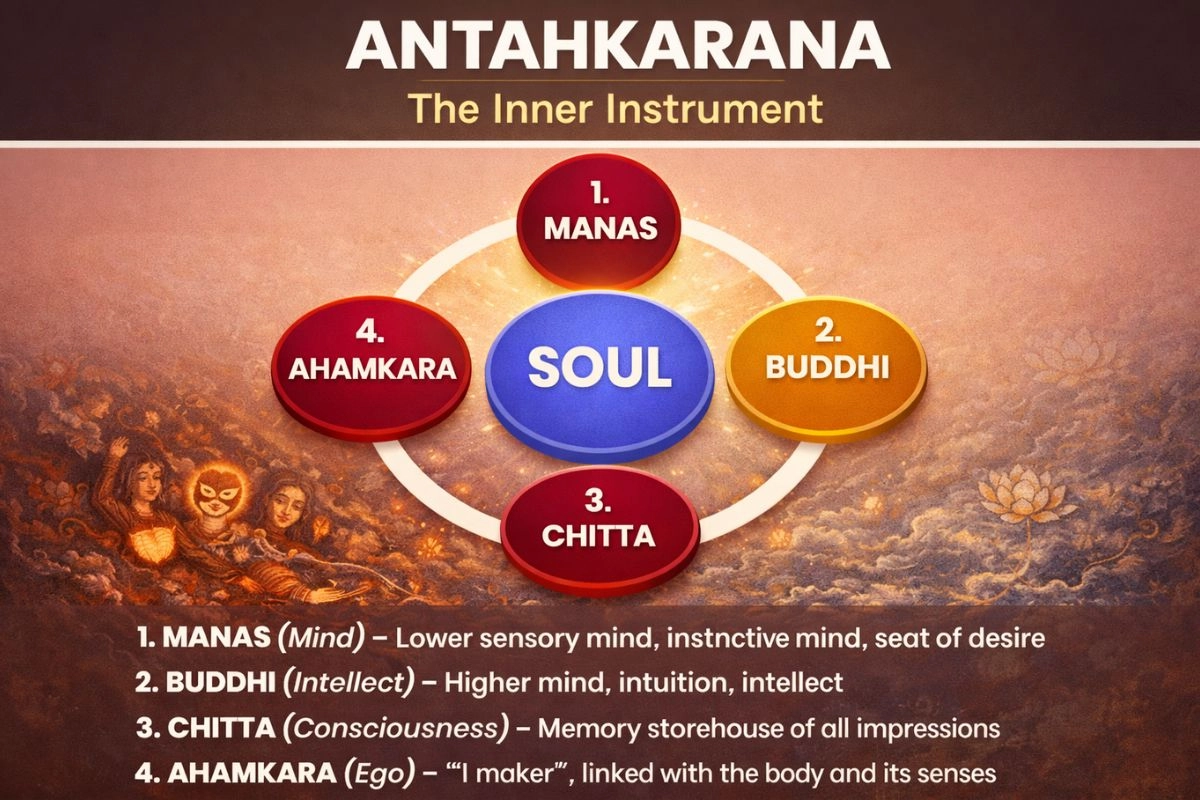
In Ayurveda, “Manas” & “Budhi” are essential functional components of the “Antahkarana” or the inner instrument, which when purified & properly aligned, serve as the pathway to Moksha. They act as mediators between the senses (indriyas) & the Atman (soul).
Their mismanagement leads to “Pragyaparadha” (intellectual error) which is considered as the root cause of all disease both bodily & mental. It leads to worldly bondage.
Manas called “ubhayendriya” (both sensory & motor) responsible for sensing / thinking & resolution. An uncontrolled mind which is distracted or desire driven binds the soul through ‘Raga’ attachment, Anger “krodha” & ‘Moha’ delusion to the material World.
Purification of the Mind is acheived by cultivating Satva Guna.
Budhi :- The higher intellect or discriminative faculty acts as an “inner counsellor”, discerning TRUTH from FALSEHOOD.
Budhi aids “Viveka” in breaking the cycle of rebirth.
A refined, Sattvic Budhi (also associated with Medha or Memory) allows one to overcome PRAGYAPARADHA & thereby leads to Moksha.
In Ayurveda a multi-faceted approach involving diet (Ahara), Dinacharya – Sadvrutta (Proper Behaviour) (like Yama Niyamas of Yoga Sutra) specialized herbs (Ashwagandha; Vacha; Guduchi etc.) daily routines & mental discipline is advised to purify the mind & intellect and gain Sattvic state.
By integrating the above principles/practices Ayurveda seeks to not only prevent mental decline but also to promote a state of “Sat – Chit – Ananda”.
TESTIMONIALS
Digital Detox
Upcoming Courses & Retreats
![Logo of Bharat Yogavidya Kendra [BYK]](https://bharatyogavidyakendra.in/wp-content/uploads/2025/07/BYK-Logo-300px.png "BYK-Logo-300px")
Thank you for reading
In this issue of Yogavidya, we have:
- Cognitive Distillation through Vedantic Inquiry
- Talk with M
- Evolving the Mindset via Non-dual Philosophy
- Vivekachudamani by Swami Turiyananda
- Refinement of the Mind through Advaita Vedanta
- Sharpening Mental Clarity through Advaita
- Dissolving the Ego in the Ocean of Non-duality
- Journey of a Satsangis – Part 2: 1st Impressions of India
- Cultivating Sattva through the Lens of Oneness
- Digital Detox
- Yogavidya | BYK Monthly Newsletter