The Mind in the Cave, the Practice at Home
For two months we have been inside old texts. The Yoga Upanishads told us the mind is the cause of both bondage and freedom. The Yoga Vasishtha spent thirty-two thousand verses showing us that the world we experience is largely the mind’s own making. This month we turn to someone who took teachings like these and lived on them, alone, for twelve years.
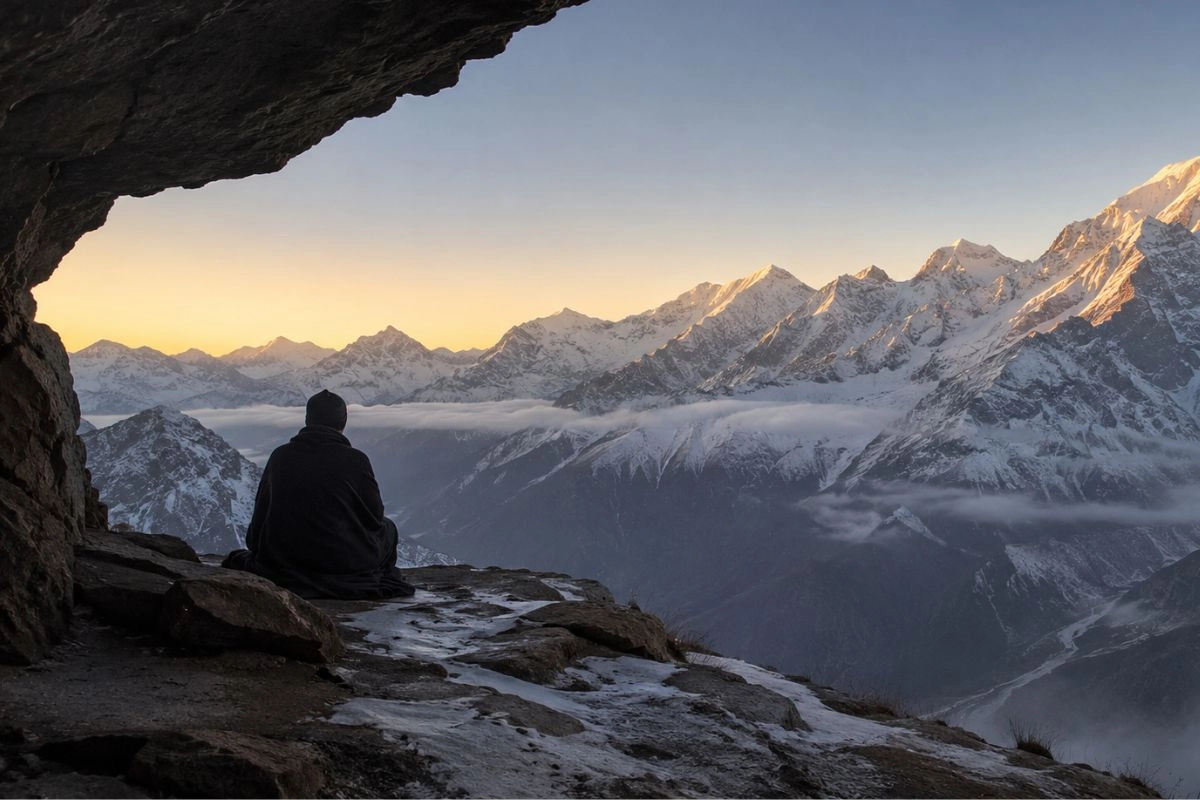
Tenzin Palmo was born Diane Perry in London in 1943, the daughter of a fishmonger. At twenty she took a boat to India, where she became a nun in the Tibetan tradition, and in 1976 she moved into a small cave in the Lahaul valley, high in the Himalayas. She stayed there twelve years. She grew her own vegetables, slept upright in a wooden box, and spent the days watching her mind. When she came out, people kept asking her what she had found. Her answers became talks given around the world, and the talks were later gathered into a small book called Into the Heart of Life.
The surprising thing about the book is that it is not really about caves or retreats. It is about the things all of us deal with every day. She writes about why we find it so hard to accept that everything changes, and how easily we confuse holding on to someone with loving them. She also writes about the way the mind spends its whole day swinging between praise and blame, gain and loss, without our even noticing the swing. Again and again she comes back to the point that the real practice happens at home and at work, in the middle of ordinary life, and not in a cave.
Guru Purnima also falls in this month, which makes it a good month to spend with a teacher who asked nothing of her listeners except that they honestly look at their own minds.
The book is short and written the way she speaks. A chapter a week is a good pace for it.
Om Tat Sat.
In Search of Truth: From a Fragmented Mind to Wholeness
Sri M Explains
Talk with M
BLOG POST
Chittam Eva Hi Samsarah (The Mind Itself is the World)

In May and June we read texts, first the Yoga Upanishads and then the Yoga Vasishtha. This month we are reading a book by someone still living, and in her case the life behind the book is as much the teaching as the book itself.
Tenzin Palmo was born Diane Perry in London in 1943. Her father sold fish in the East End and the family lived above the shop. There was nothing in that childhood to suggest India or the Himalayas. At eighteen she happened to pick up a book on Buddhism, and by the time she finished it she had the strange feeling that she was not learning something new but recognising something she had always thought, without ever having had a word for it.
BOOK REVIEW
The Untethered Soul
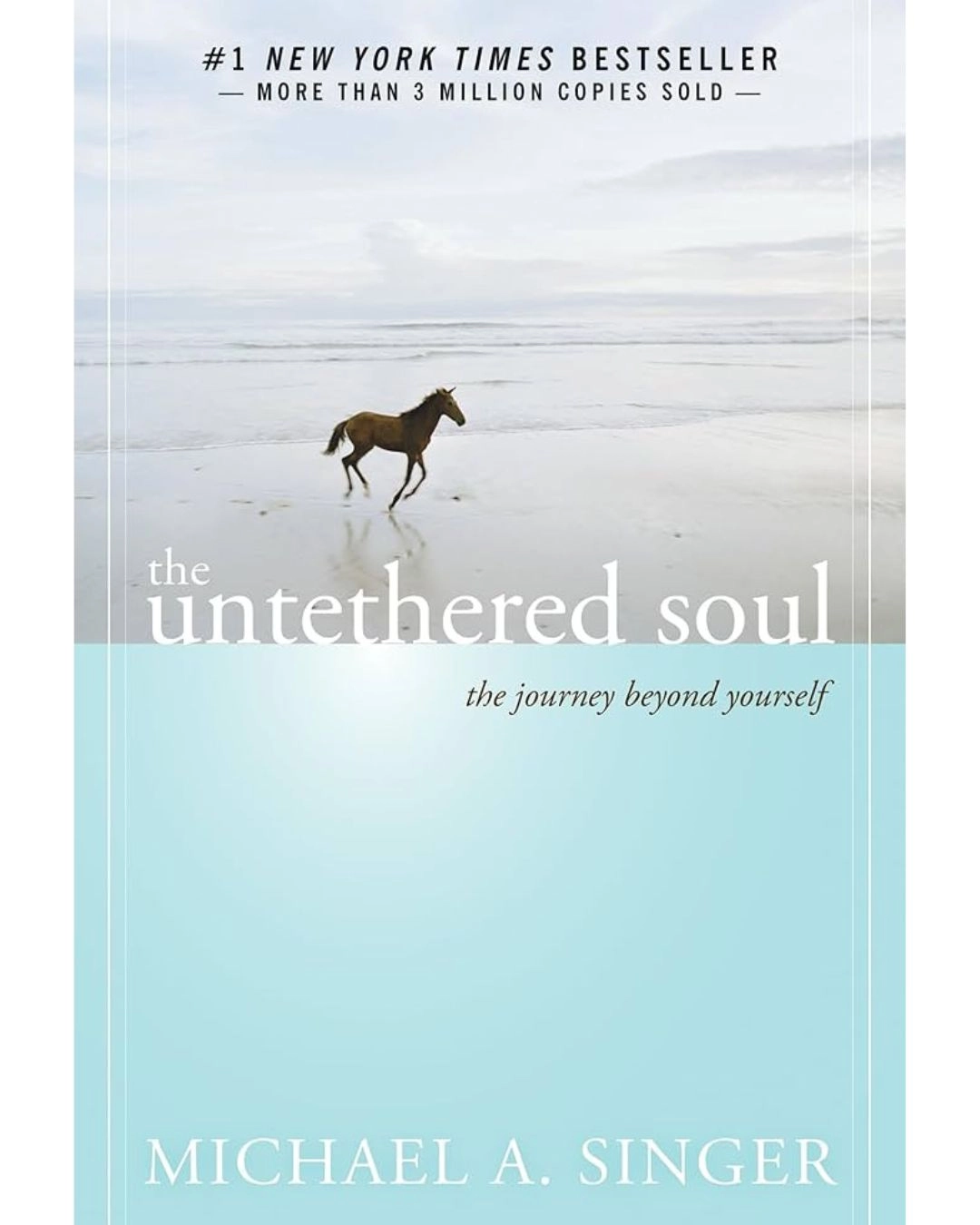
The central theme of the book Living Untethered is developing a deeper understanding of the mind and the heart and the nature of things. The author, Michael A. Singer describes how the personal mind, comprising personal thoughts and emotions, is formed, and how this personal mind interacts with the objects of consciousness, creating experiences that shape our lives. The book reveals that much of our energy is spent serving the personal mind – trying to be okay inside by constantly seeking pleasure and avoiding discomfort and trying to arrange the outer world to its preference. That causes a constant fight and disharmony with the Universe. The solution is to serve the present moment instead. The book discusses that by embracing fully the experience of each moment as it unfolds, and letting it pass through, without clinging or resisting can help us to detach ourselves from the lower states and live a life of inner freedom.
The book examines that when one stops to constantly serve the personal mind the accumulated mental patterns begin to dissolve and the Energy or Shakti which is constantly trying to push out these patterns will start to flow freely. This unobstructed flow of energy will then give rise to profound sense of love and inner bliss which is not dependent on anything. Ultimately this opens the gateway to higher centers and true surrender happens when Shakti merges with the source – a state described as Yoga or Self-realization.
The book begins with the exploration of the self by asking ‘who’s in there that knows it exists?’, and helps to understand that you are not what you look at, you are the one who is looking. The nature of the self is always conscious, the entity inside due to which one can describe their experience of sleep or coma or near death experience after returning to the waking state.
Broadly, life experiences three objects of consciousness – the outer world, the thoughts, and emotions. By understanding the origin and nature of these objects, it becomes easier to appreciate every moment as it unfolds. The moment unfolding before us is a result of all the natural forces going back billions of years that has caused it to be as it is. We further understand that surrender does not mean surrender to life, but rather to our resistance to the moment unfolding before us.
The book further delves into the nature of the mind and how mental patterns are formed and stored inside, and how they start creating a mess. It explains how one can look and experience things in a way that these mental patterns are not stored and the existing ones are released.
Mind is broadly classified into four layers. The first layer is the here-and-now layer where the rendering of the present external experience is taking place. The next layer is called the samskara layer, the stored patterns from the past that the self could not let go of, after the external experience was over. Third layer is the personal- thoughts layer, one that is trying to solve the discomfort created by the samskaras, and with which the self identifies itself most with. The combination of these three layers is called as the personal mind. In order to be okay from inside, that is to say, not to trigger the samskaras, the personal mind has taken up the task of getting the world to unfold the way it wants. The mind actually thinks that the world should be the way it wants it to be. By deeply understanding the nature of these two different sets of forces (personal mind and the world), soon one can realize the folly of the personal mind in pitting itself against the Universe.
The fourth layer is the abstract or the pure intellectual mind. One can practice to be in the intellectual mind by practicing to focus on the present moment, and using the intellect to create and do things of an impersonal nature. Alluding back to the question, that is it really intelligent for the self to devote its life to fighting with life, so that it aligns with one’s preferences? Fortunately there is a higher way to live life, and that requires us to change how we perceive and interact with the mind and the moment unfolding before us.
The book presents detailed explanation of thoughts, distinguishing between automatic and willful thoughts, how and why they are created and how the brilliant mind is always trying to release the stuck impurities by automatically generating thoughts in waking and dream states. Next, comes an insightful discussion on emotions. Emotions are very sensitive vibrations of energy emanating from the heart which rise to the mind thus creating thoughts. The stored patterns of the past are trying to release their energy from the heart, which in turn is getting the mind active.
The description of why the heart closes and opens is very interesting and illuminating. The heart goes through fluctuations as different situations occur. Truly great beings have understood the heart by spending years objectively observing the heart’s behavior rather than running after what it wants and running away otherwise.
For the person seeking spiritual growth, the dynamics of the opening and closing of the heart, and the interaction between the Shakti or Energy flow and the blockages are to be understood. Without such an understanding, one’s life can become about serving the stored patterns that dominate our life, with no purposeful intent or direction to life. What then can a person who is dealing with a difficult inner pattern or distorted Energy flow do? At this point, the book suggests the one lasting solution, to reflect on the question – ‘Who is noticing all this?,’ and to realize that none of the shifting energy patterns is you. The seeker is encouraged to be the seer of the many patterns, and that would be the path to Self-realization.
One of the profound insights of the book is its exploration of the secrets of the heart. These secrets are revealed to anyone who is willing to work on themselves and devote their life to the practice of living a life with acceptance of reality and letting go of personal preferences. Just as a pianist gets better with practice, so too can a spiritual seeker practice letting go and thus transmute blocked energy flow into a powerful spiritual force of love and joy. This will eventually open the gateway to the higher centers and frees one out of the human predicament.
Lastly, the book explains in detail several techniques for freeing oneself, namely positive thinking, instilling a mantra in the mind, and witness consciousness which is the deepest technique that involves deeply relaxing and releasing.
What made Living Untethered especially meaningful to me was its ability to invite deep self-reflection. The author discusses profound spiritual concepts with clever observations and light-hearted humor that often made me chuckle and reflect on my own life. The author skillfully incorporates phrases from the Bible and Buddhist teachings and illuminates their deeper meaning by relating them to the concepts explained in the book.
In conclusion, Living Untethered is a book that teaches that Life is itself a great teacher. With the insight into where each moment is coming from, one is better able to accept the moment that is unfolding before us. Accepting each moment with an open heart, and directing our attention towards observing the behavior of the heart and the mind – rather than acting upon serving it- one can transmute the stuck energies into a free flow of Joy which is independent of anything. I highly recommend this book to anyone who wish to cultivate deeper self-inquiry, self-discovery and inner transformation.
JOURNEY OF A SATSANGI
Part 6: First Satsang with Sri M
Hello and welcome to Part 6 of the Journey of a Satsangis! In the previous episode, I visited the Peepal Grove School for the first time and met Sunanda, Viraj and some of the schools’ teachers and students. For those who may be joining the story here, Part 1 of the journey began in the February BYK newsletter, with subsequent chapters continuing in later editions. Each part traces a different stage of the journey and I’m grateful to be able to share my experiences here with you.
I left PGS feeling hopeful that I would have the opportunity to volunteer there and was looking forward to seeing Diane and Prabs in Delhi for the Christmas and the New Year. The Peepal Grove School is about 200 kilometres from Bengaluru, and the drive takes roughly four hours as you wind your way through the rural roads of Andhra Pradesh and Karnataka. Many of the roads are little more than one and a half lanes wide, so when two vehicles meet, each driver has to move to the side to make just enough room for the other to pass. To my surprise, what initially looked like complete chaos worked remarkably well, and the traffic seemed to flow with an unspoken rhythm and cooperation.
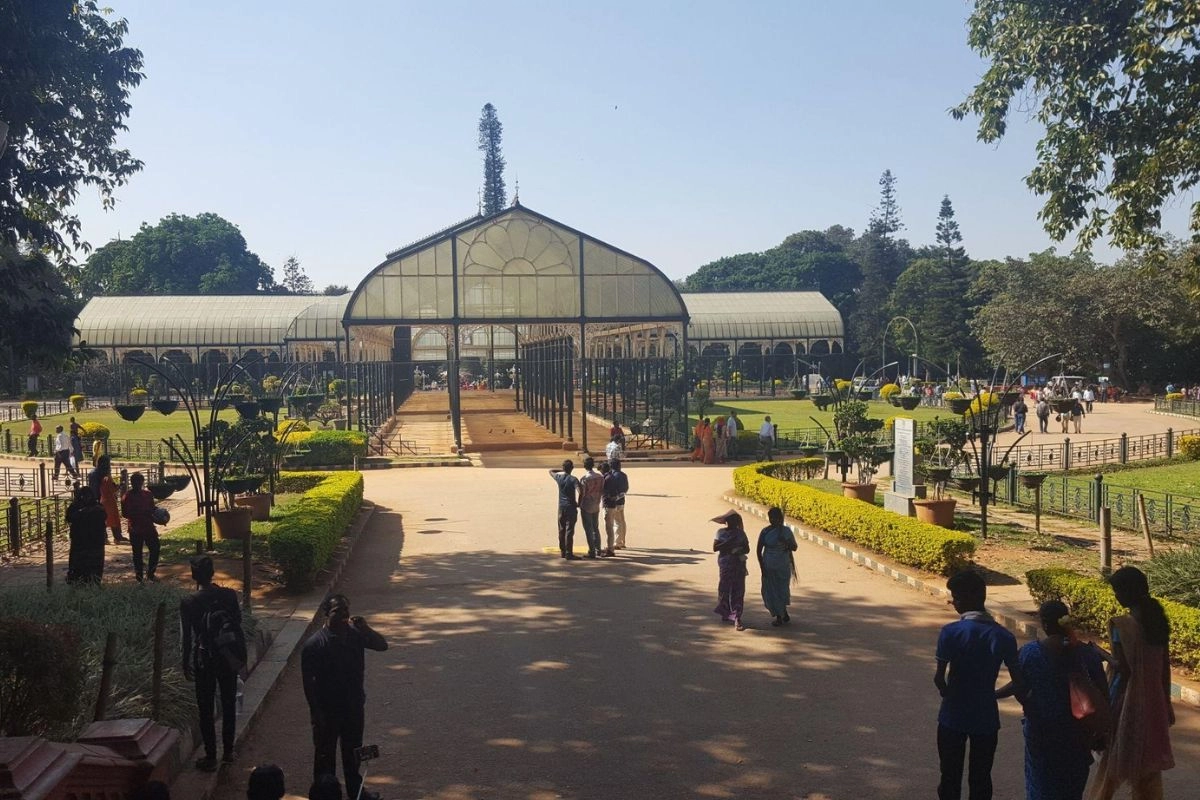
I have to say that, of all the cities I’ve visited in India, Bengaluru is one of my favourites. The weather is pleasant throughout most of the year, with temperatures typically ranging between 15°C and 30°C, making it an easy city to explore on foot. As one of India’s leading technology and start-up hubs, the city also has a vibrancy and sense of optimism that is hard to miss. There is a feeling that people have come from all over the country to build something new and pursue their dreams.
I spent a couple of days in Bengaluru, taking in some of the sights and sounds, including Lalbagh (a large garden in central Bengaluru and one of my favourite spots in the city), the Big Bull Temple and the Bengaluru Palace before heading to Delhi.
The flight from Bengaluru to Delhi took about two and a half hours. I found that India’s domestic airlines such as IndiGo made travelling around India relatively affordable and convenient. Once I arrived in Delhi, Prabs was kind enough to send a driver to pick me up from the airport and take me to his home in Gurugram. He lived in a peaceful apartment complex on the outskirts of the city, far enough from the hustle and bustle that the traffic and noise were much more manageable, yet close enough that getting into the city was still convenient.
Prabs introduced me to his wife, Pushpi, and their son, Aayan. From the moment I arrived, their family welcomed me with such warmth and generosity that I immediately felt at home. They truly opened their home to me and made my stay incredibly comfortable.. A couple of days later, my wife, Diane, arrived from Canada, and the five of us quickly settled in to learn about each other and our journeys. Prabs was an incredibly generous host, and over the next two weeks we explored the sights of Delhi, shared many meals, and got to know one another much better.
During our conversations, I learned that Prabs himself had only discovered Sri M a year or two earlier, when Sri M had passed through Gurugram and Delhi during his remarkable Walk of Hope. Over the course of 2015–2016, Sri M walked approximately 7,500 kilometres across India, meeting people from all walks of life and promoting harmony, peace, and understanding. It was fascinating to realize that through Prabs, I was also somehow intricately linked to Sri M’s walk of hope.
Our time together flew by and before we knew it, it was time for Diane and I to head to the Pathway School to attend our first Satsang with Sri M. Prabs informed me that the Pathway School was one of the premier schools where many of the Delhi elite send their children to school. He spoke highly of its beautiful campus and, once again, generously offered to drive Diane and me there.
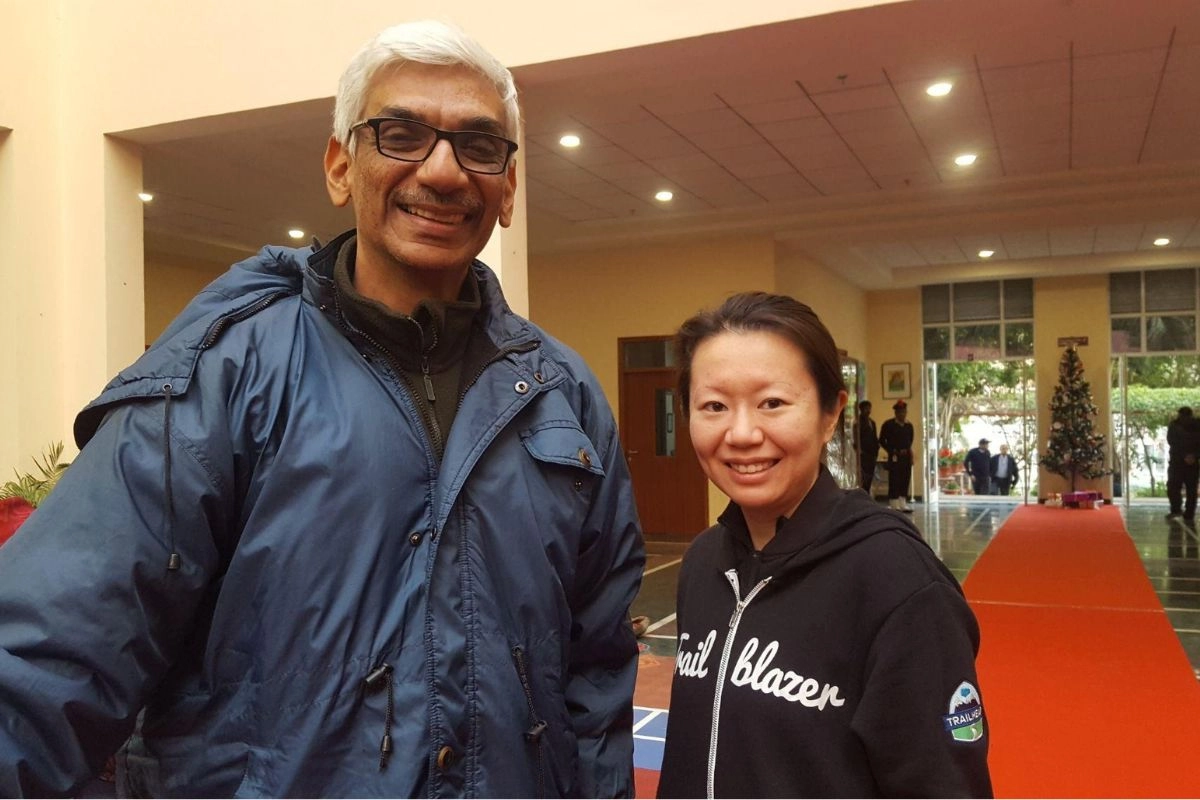
The Satsang at the Pathway School was a three day program from January 7-9, 2018 with attendees staying at the dormitories in the school.
What we were completely unprepared for was just how cold the winter nights could get on campus. Many people assume that because Canadians are used to harsh winters, we must be immune to the cold. While it’s true that Canada gets much colder than India, there’s one important difference: virtually every home in Canada is heated, so indoor temperatures are usually a comfortable 20–25°C.
At the campus, however, the temperature in our room dropped to around 4°C during the night. Diane and I quickly discovered that Canadians are only brave in the cold when there’s a furnace nearby! We ended up wearing multiple layers of clothing to bed and even hugged our laptops for a little extra warmth as we tried to fall asleep.
The Satsang was attended by around 200 people and I learned that most of the people helping organize the event were devotees of Sri M who were happy to volunteer their time for his cause.
The first time I saw Sri M in person was on the campus grounds. Diane and I were standing off to the side watching Sri M and a procession of his followers walking by. Somehow he noticed the two of us and came over to us.
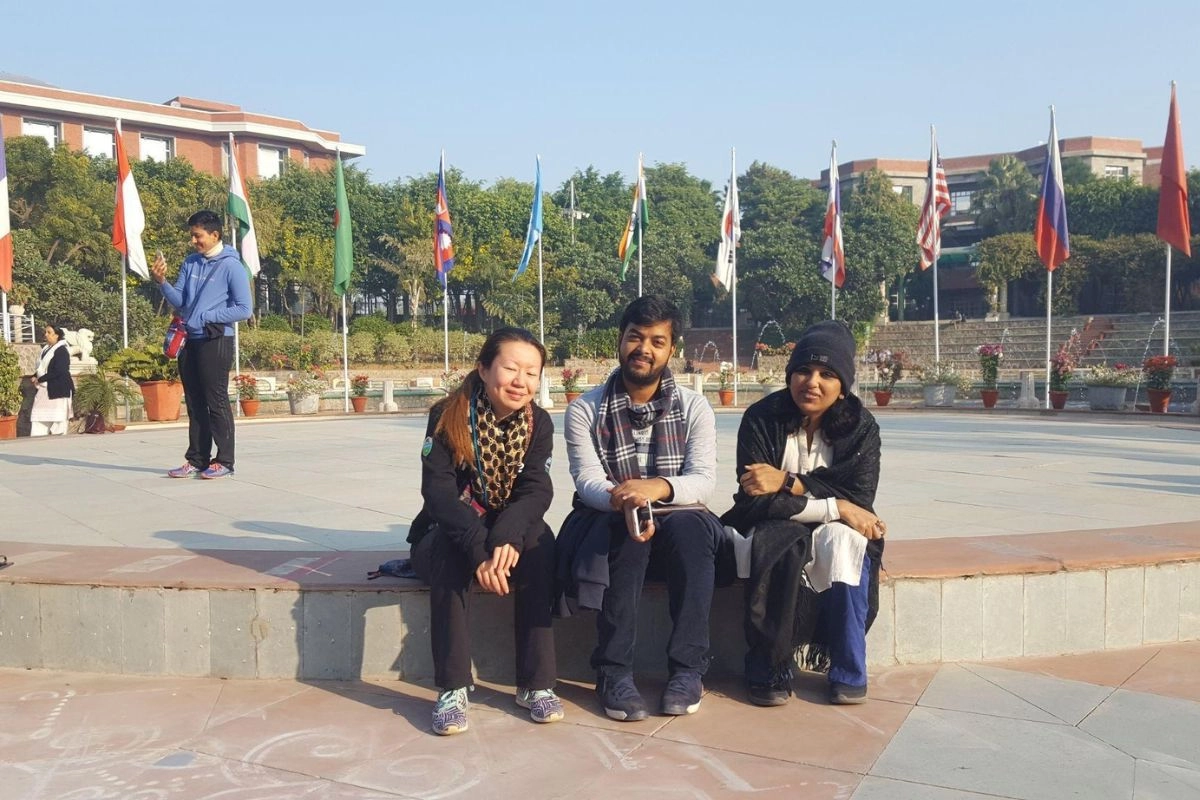
Throughout my journey as a Satsangis, I have heard many people describe what it is like to be in Sri M’s presence. Some have shared that they are overcome with emotion, finding themselves in tears without quite knowing why. Others have spoken of feeling a sense of awe or even nervousness in his presence.
My own experience was different. What I felt most was a deep sense of calm. There was an ease about him that immediately put me at peace. He often wore a gentle, slightly mischievous smile, as though he quietly appreciated the humour and mystery of life. It was the kind of smile that made you feel welcome and completely at ease.
As he walked over to Diane and me, he smiled warmly and said:
Sri M: I haven’t seen you two before. Where are you from?
Sam: Sir, we are from Canada and this is our first time attending a Satsang with you.
Sri M: Ah I see
Sam (jokingly): Actually Sir, I’m trying to get a volunteer position at your wife’s school, the Peepal Grove School, so can you please put in a good word for me?
Sri M chuckled and wished us well before moving on to speak with some other followers.
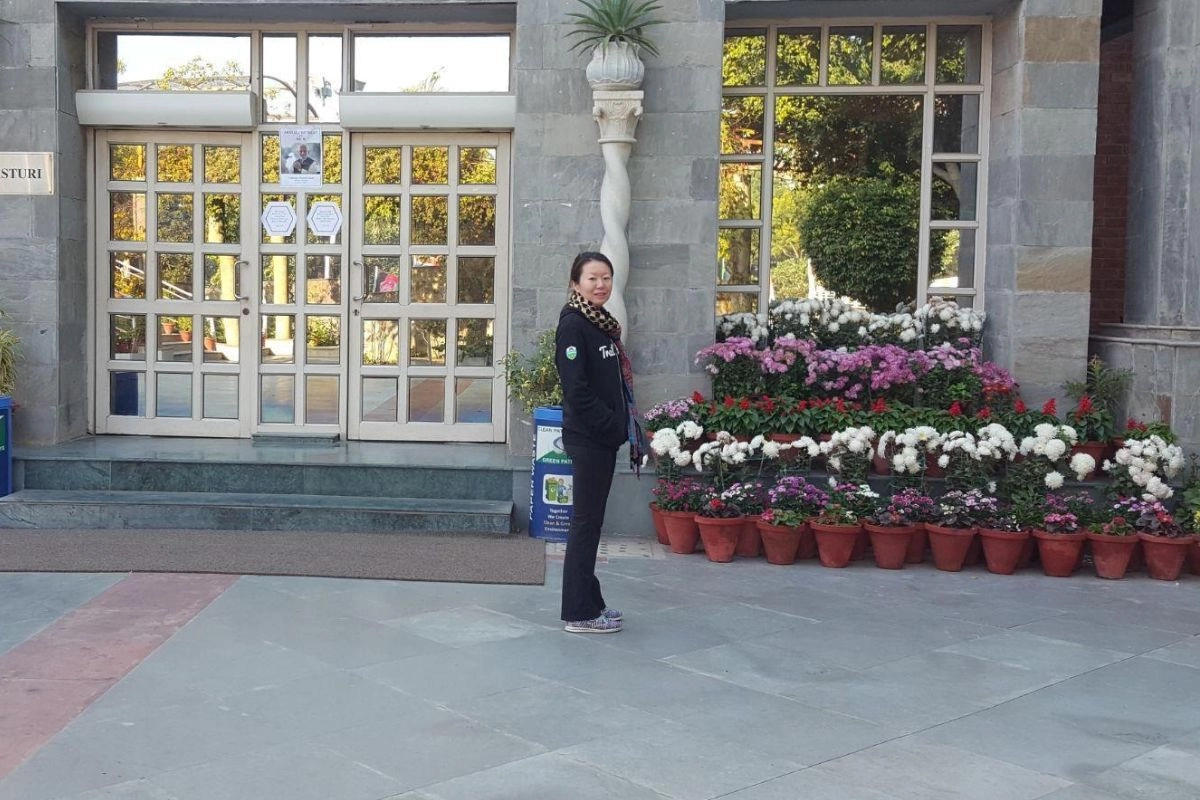
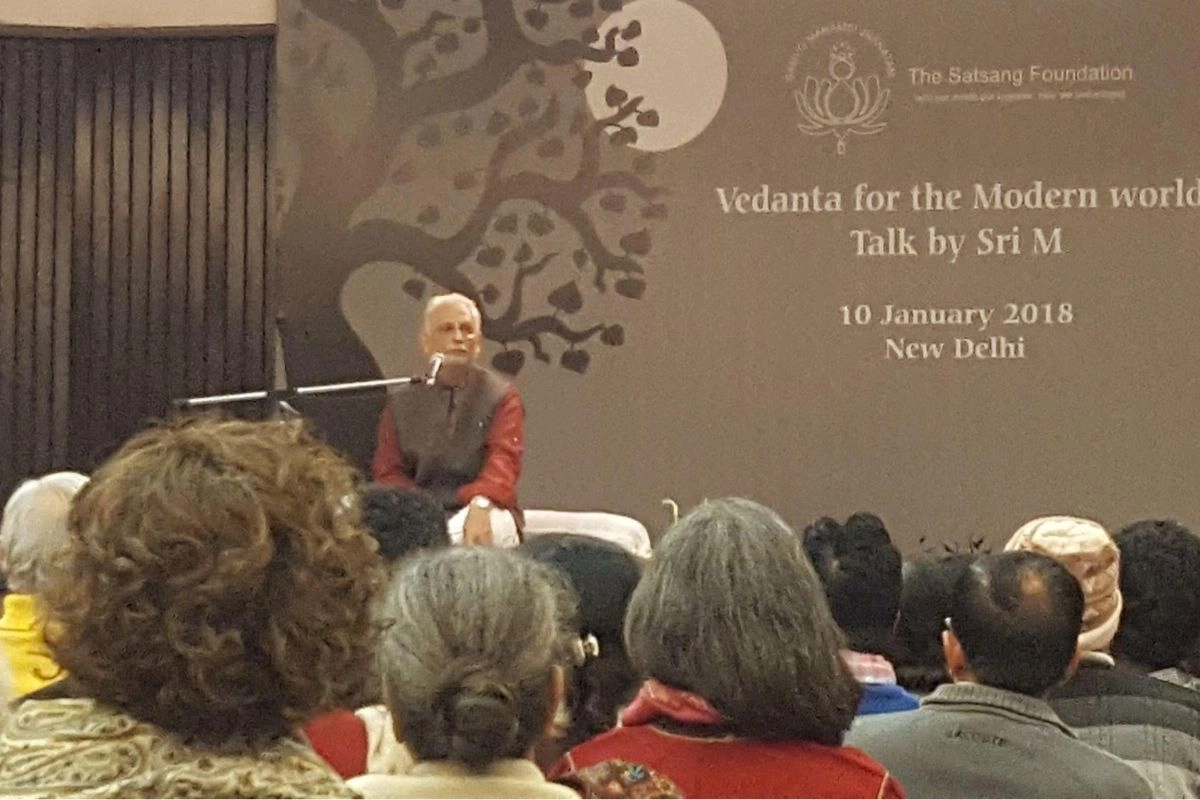
During the Satsang, Sri M gave two talks each day—one in the morning and another in the evening—sharing the teachings of Vedanta and reflecting on what it means to live a truly spiritual life.
Whenever I attend a conference or listen to a speaker, I often find myself noticing the difference between someone who is speaking from academic knowledge and someone who is speaking from lived experience. There is a certain authenticity that is difficult to describe but easy to recognize.
Listening to Sri M, I had the distinct impression that he was speaking from direct experience rather than theory alone. His words carried a quiet conviction and simplicity that made even profound spiritual ideas feel accessible and real. Whether discussing meditation, the Upanishads, or everyday life, there was a consistency between what he taught and the way he carried himself that left a lasting impression on me.
The Satsang also gave Diane and me the opportunity to receive initiation into Kriya Yoga from Sri M. At the time, Kriya Yoga was open to anyone attending the Satsang who wished to receive the initiation.
Looking back, I have to admit that although I was initiated into Kriya Yoga during this retreat, I did not fully understand its significance at the time. It was only years later, through continued study, practice, and deeper exploration of yoga itself, that I began to appreciate the depth and importance of Kriya Yoga and the transformative role it can play on the spiritual journey.
On the last day of the Satsang, all of the attendees lined up to give pranams (or thanks) to Sri M. While waiting for our turn to be in front of Sri M, I spoke to Diane.
Sam: You know what, when I go down to do my pranams to Sri M, I’m going to ask him if he can find some time to speak with me about science, consciousness and spirituality.
Diane (half jokingly): uuuh are you stupid? Look at all of these people lined up to have just a moment of Sri M’s time. Do you think he’s going to have time to speak with someone like you?
Sam: Well we won’t know if we don’t try…
So I did just that. When I went down for my pranam I said to him
Sam: Sir, I have been thinking about consciousness but from a mathematical perspective and somehow it’s taken me all across India and somehow in front of you. Is there a chance you can find some time to discuss this topic with me?
Sri M: Actually this is a very important topic. Leave your phone number with my secretary and I will get back to you.
I was both amazed and delighted by Sri M’s response. I left my contact information with his secretary and looked forward to the possibility of speaking with him. As it turned out, that conversation would not happen until a year later, in December 2019, but the wait was well worth it. I will share that experience in a later chapter of my journey.
With the Satsang complete, Diane and I returned to spend a few more days with Prabs and his family before continuing on with the next part of our journey. Looking back, those days were a wonderful reminder of the unexpected connections that can arise when we remain open to new experiences and the kindness of others.
To be continued…
Satsang is a Sanskrit term derived from sat (meaning truth) and sangha (meaning company/community) and refers to gathering with like-minded individuals, often with a guru, to listen to spiritual teachings aimed at elevating consciousness and fostering spiritual growth
ALUMNI CONTRIBUTION
Bringing Spiritual Practice Into Everyday Life

In Sanskrit, every word has a root or dhatu and the meaning of the word is understood based on the root and the context. Using that analogy, Spiritual is Spirit + ritual. Spirit is our inner essence, our state of mind and can even be described as our attitude to anything. A ritual is something we perform time and again. Put together, then, Spiritual practice is nothing but Karma Yoga. It is our repeated regular daily actions done in a manner that helps us discover our inner self. So “daily life” and “being spiritual” are, in reality, one and the same!
The Buddhist concept of ‘Mindfulness’ is not just a method to perform every action but is also the essence of spirituality. For most of us, the mind wanders into tomorrow even as we perform actions today. We let worry, anxiety and especially expectations of the future drive our mind. To quote The Revered Buddhist Monk Tenzin Palmo “true security comes from comfort with insecurity”. This is the state of a ‘Gnani’ or a ‘Sthithaprajna Lakshana’ as described by Lord Krishna in the Bhagavad Gita. The only means we have, to reach that ‘comfort zone’ is to make our daily life a spiritual one.
She says two fundamental signs of existence are ‘dissatisfaction’ and ‘impermanence’. And we ignore these two elephants in the room! We look at spirituality and daily life as mutually exclusive to the other and hence our constant dissatisfaction with everything in life. We carry our work troubles home and let that affect our personal relationships. It happens so seamlessly that we don’t even realize it. On the contrary, we attend Satsangs, read scriptures and pray at the alter, but ironically, don’t carry that mood back into our relationships! If only we stayed with that ‘spirit’ our daily life experiences would be more pleasant and smooth. We believe that the spiritual and the material life are parallel roads that cannot meet. We see and experience impermanence, but still pretend ignorance. Understanding that we have an expiry date, much like the objects we use, we ought to maximize our true potential before the battery runs down. So, how do we motivate ourselves? Jetsuma Tenzin Palmo in her book “Into the Heart of Life” also mentions that motivation has 6 roots. Clarity, Compassion and Detachment are the positive roots. Delusion, Greed and Anger are negative roots.
Shakespeare famously said a rose called by any other name still smells as sweet. As I read excerpts from that book, I realized that religions or paths may differ but Truth is One. From delusion to detachment and from greed to compassion, she seemed to echo what Lord Krishna told Arjuna millennia ago– our attitude to actions matters most, transforming every mundane activity into a spiritual one.
Can we practice compassion and detachment in daily life? Every action motivated by these two roots brings clarity, watering and nurturing our life into an ever-blooming spiritual plant.
A gratitude practice is a very helpful tool to spiritualize our daily life. Despite problems, we all have atleast one thing to be grateful for every single day.
A simple act of letting a harried customer go ahead in a supermarket checkout counter brings out compassion hidden within us. It is a small act but it starts the spiritual chain. That person may remember to pass on the courtesy to some other restless person in some other setting, some other queue, someday.
A dispute at home on what to eat for dinner? Give in to the other, afterall, Krishna says “pachāmy annaṁ chatur-vidham! He is all types of food and what we consume is His Prasadam. Such seemingly inane practices slowly bring detachment from meaningless deterrents and helps us progress spiritually.
Some of us are hoping to go for the sacred Kailash Yatra. Every little exercise step we walk today, every asana performed dutifully today will culminate into the ability to do the Parikrama at Shiva’s feet months from now. A body that’s rigid is now tamed by the mind and the inflexible mind has bent to the intellect because there is clarity of purpose and of the goal. Because of clarity, the slow and painful preparatory process has become a ‘sadhana’. If we look at our workplace and home as an abode of Divinity and navigating the daily bottlenecks as our Parikrama, the annoying and unimpressive routine tasks suddenly become our sacred preparation for a journey to reach Him. Spirituality spontaneously becomes our daily life.
DEEPTI VEPAKOMMA
2026 January 200 hour online TTC student
ALUMNI CONTRIBUTION
मैं

मर्यादा पुरुषोत्तम राम भी मैं, सिया हरण करने वाला रावण भी मैं
भोर का उगता सूरज भी मैं, अमावस्या का काला, घोर अंधेरा भी मैं
मंदिर में चढ़ता सुर्ख़, गुलाबी कमल का फूल भी मैं, उस कमल को बसेरा देने वाला कीचड़ भी मैं
कृष्ण प्रेमी मीरा की पाक़ भक्ति भी मैं, शूर्पणखा की भटकती दृष्टि भी मैं
तेरा मार्गदर्शन करने वाला सद्गुरु भी मैं हूं, तुझे तेरी राह से भटकाने वाला तेरा चंचल मन भी मैं हूं
नवशिशु के रूप में जन्म लेती नई जिंदगी भी मैं हूं, मणिकर्णिका घाट पे जलती चिता की राख भी मैं हूं
सगुण, साकार परमेश्वर की मूरत भी मैं हूं, निर्गुण, निराकार भाव का अनुभव भी मैं हूं
फूल भी मैं, कांटे भी मैं
सूरज की गर्मी भी मैं, चंद्रमा की शीतलता भी मैं
मां के आंचल का प्यार भी मैं, योद्धा की तलवार से हुआ नरसंहार भी मैं
दुल्हन के जोड़े का सुर्ख़ लाल भी मैं, तेरी बेरंग जिंदगी का उजड़ा हाल भी मैं
सही भी मैं, गलत भी मैं
पाक भी मैं, नापाक भी मैं
प्रेम भी मैं, क्रोध भी मैं
स्वर्ग भी मैं, नर्क भी मैं
खूबसूरती की चरमसीमा और तेरी घृणा का पात्र भी मैं
पूर्व भी मैं, पश्चिम भी मैं
विष भी मैं, अमृत भी मैं
देव भी मैं, असुर भी मैं
चंचल भी मैं, स्थिर भी मैं
तेरे ज़हन में उमड़ते प्रश्न भी मैं, उन प्रश्नों का उत्तर भी मैं
मैं भी मैं और तू भी मैं
अणु भी मैं, ब्रह्मांड भी मैं
सर्वस्व हूं मैं, पूर्ण हूं मैं
पर अंत में तेरे चरणों की धूल हूं मैं
YOGA GUIDE
Yogic Practices for Inner Happiness and Contentment
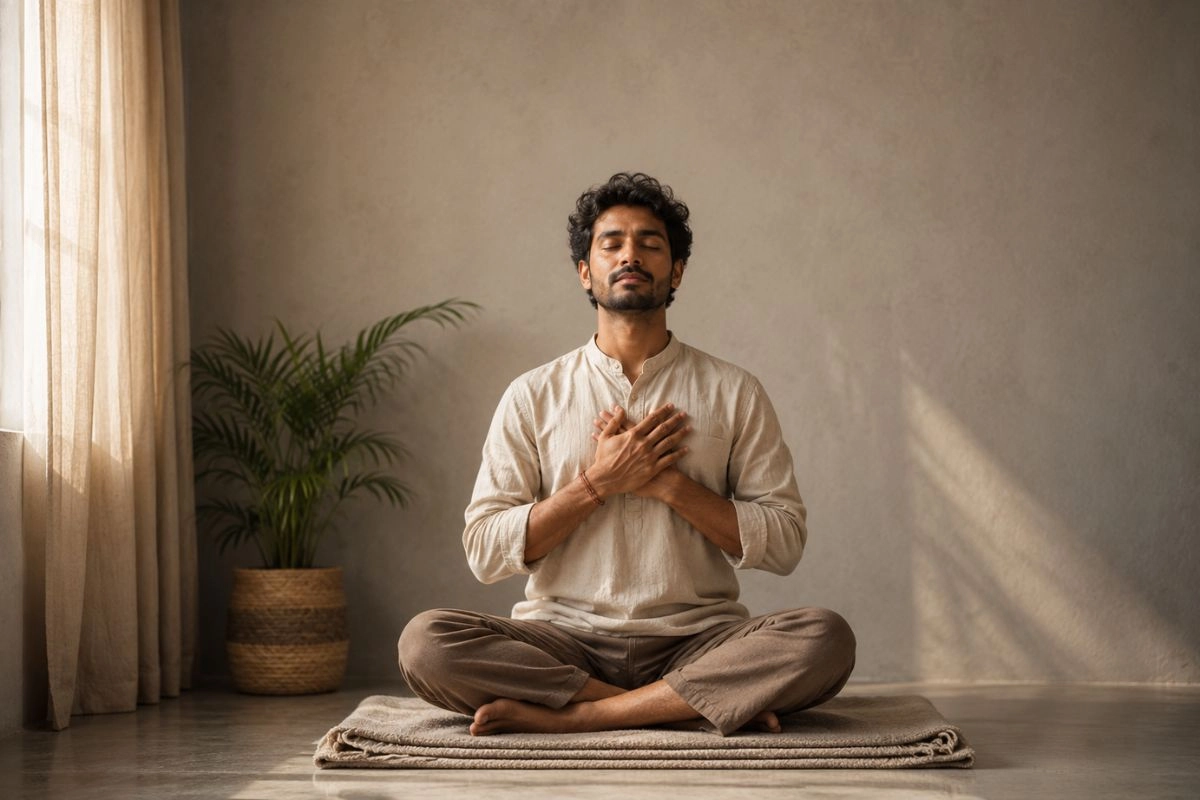
1. Simple Asanas (Postures)
- Balasana (Child’s Pose): Rest your forehead on the mat. This immediately grounds your energy, turns your attention inward, and signals safety to your nervous system.
- Sukhasana with Hridaya Mudra (Easy Pose with Heart Gesture): Sit cross-legged. Place your right hand over your heart center and your left hand over your right. Breathe directly into your hands to cultivate self-compassion.
- Bhujangasana (Gentle Cobra Pose): Keep this low and soft. Gently lift your chest to open the heart space (Anahata chakra) without straining, inviting a sense of vulnerability and joy.
- Viparita Karani (Legs-up-the-Wall Pose): Lie on your back with your legs resting up against a wall. This deep restorative pose releases physical fatigue and deeply settles an anxious mind.
2. Pranayama (Breathing Practices)
- Nadi Shodhana (Alternate Nostril Breathing): Use your thumb and ring finger to alternate breathing through your left and right nostrils. This balances the solar and lunar energies in the body, bringing immediate mental clarity and equanimity.
- Dirga Pranayama (Three-Part Breath): Breathe deeply into your belly, then your ribcage, then your upper chest. Exhale in reverse. Filling your entire torso with breath creates a profound physical sense of abundance and fullness.
3. Mindfulness & Reflection
- Santosha Meditation: Dedicate the first two minutes of your seat to mental gratitude. Silently name three ordinary things you are grateful for in that exact moment (e.g., the warmth of the room, the breath in your lungs).
- Sankalpa (Positive Resolve): Before you move, set a simple, present-tense intention focused on contentment. Repeat mentally three times: “I am complete exactly as I am.“
YOGA RESOURCE
Staying Spiritually Connected Throughout the Day

1. Swami Vivekananda: Service as Direct Worship
Swami Vivekananda revolutionized modern Hindu thought by mirroring the Buddhist ideal of the Bodhisattva (serving others to alleviate suffering). He introduced the concept of Daridra Narayana—seeing the Divine in the poor, weak, and ordinary people around you.
- Work as Worship: He taught that you do not need to abandon your job. Instead, treat every daily task as an offering to humanity.
- Ego Erasure: By focusing entirely on helping others in your workplace or family, you naturally dissolve the self-centered ego, exactly matching the Buddhist practice of selflessness.
2. Ramana Maharshi: The “Witness Consciousness” during Chores
Advaita Vedanta master Ramana Maharshi taught a path of self-inquiry (“Who am I?”) that shares an incredibly close psychological space with Zen Buddhism.
- The Internal Witness: He argued that you do not need to sit in silent meditation for hours. While washing dishes, typing an email, or walking, you simply maintain the attitude of a detached observer (Sakshi).
- Mindful Disidentification: Just as a Buddhist observes thoughts without clinging to them, Ramana urged people to watch their daily emotions and stress arise, remembering: “I am the silent awareness, not this passing anxiety.”
3. Conscious Living vs. Compulsive Reactivity
Guru focuses heavily on modern, practical integration that strips away heavy religious ritualism.
- Breaking Mental Loops: His core teaching centers on moving away from “compulsive” psychological reactions to “conscious” actions. This directly aligns with the Buddhist practice of catching your habitual karmic loops before they dictate your behavior.
- Total Responsibility: He frames daily spiritual practice (Sadhana) as taking absolute responsibility for how you experience your current moment, whether you are stuck in traffic or sitting in a boardroom.
4. Swami Sivananda: The “Serve, Love, Meditate, Realize” Formula
Swami Sivananda, a prominent 20th-century guru, explicitly praised the Buddha as the ultimate practical yogi. He created a highly structured framework for ordinary citizens to spiritualize their 24-hour routine:
- Spiritualizing Mundane Chores: He taught that the spirit of service must enter every nerve and cell. If you cook, cook with love; if you clean, clean with absolute presence.
- The Daily Snapshot: He encouraged laypeople to keep a “spiritual diary” to check their daily habits, anger levels, and acts of kindness, turning self-awareness into a measurable daily habit
Hindu vs. Buddhist Daily Practice
While the underlying philosophies differ slightly regarding the existence of a soul (Atman vs. Anatta), the structural execution of their daily practices is almost identical:
| The Everyday Situation | The Buddhist Approach | The Hindu Guru Approach |
|---|---|---|
| Doing Office Work | Mindfulness (Sati): Being fully present with the keyboard, breathing through tasks | Karma Yoga: Doing the job perfectly but surrendering attachment to the bonus or praise (Nishkama Karma). |
| Interacting with an Angry Person | Metta (Loving-Kindness): Recognizing their suffering and responding with active compassion. | See the Divine (Oneness): Recognizing that the same underlying consciousness (Brahman) exists within them. |
| Facing Crisis or Chaos | Anicca (Impermanence): Reminding yourself that this stressful moment will also pass. | Leela (Divine Play): Viewing the chaos as a passing storm on the surface of your unshakeable, true Self. |
COMMUNITY COLUMN
Compassion and the Awakened Heart

Jetsunma Tenzin Palmo is a prominent British-born Tibetan Buddhist nun, teacher, and author. She famously spent 12 years meditating in a remote Himalayan cave and authored the bestseller “Into the Heart of Life: Buddhist Teachings on Wisdom and Compassion”. This text offers a practical look into her essential teachings on transforming daily life through an open heart.
What Compassion Really Means: True compassion is a powerful, active mentalstate rather than a passive emotion.
Tenzin Palmo redefines compassion through three core Principles.
- BEYOND PITY: It is not pity or feeling sorry for someone; it is the sincere wish that compassion includes ourselves and all beings to be free from suffering and its root causes.
- Universal Reach: It grows naturally as we understand that everyone experiences pain, fear, loss, and uncertainty
- Born from Understanding: Harmful actions arise from confusion, ignorance, or fear. Seeing the causes behind difficult behaviour reduces hatred and helps us respond with wisdom and patience.
Says She “Spiritual practices are not meant for isolated mountain cave, but it is about how we respond to daily challenges. “ She draws a critical distinctionbetween authentic love and selfish emotional attachment:
- Attachment: Focuses on control, rigid expectations, and personal fulfilment.
- Authentic Compassion: Focuses entirely on the genuine well-being of the other person.
- The Relationship Between Wisdom and Compassion: Genuine awakening requires both wisdom and compassion working together in perfect equilibrium.
One cannot function healthily without the other:
- Compassion without Wisdom leads to emotional overwhelm, burnout, over- attachment, and rescuing behaviour.
- Wisdom without Compassion leads to coldness, intellectual detachment, and isolation.
- What Wisdom Brings to the Heart. Wisdom balances compassion by providing a clear understanding of reality: They are:
- Impermanence: Acknowledging that everything is constantly changing.
- Causality: Understanding that suffering has specific causes and conditions.
- Lack of Control: Accepting that we cannot control every single outcome.
- Personal Autonomy: Recognizing that people must ultimately walk their own paths.
- With wisdom, compassion becomes steady, resilient, and entirely free from despair.
In Buddhism, compassion (karuṇā) is the heartfelt wish that all beings be free from suffering and the causes of suffering. It is not pity, sympathy, or feeling sorry for someone. Compassion arises from recognizing that all beings, just like ourselves, seek happiness and wish to avoid pain. The awakened heart, or bodhicitta, as per Mahāyāna Buddhism emphasizes the fact that the highest spiritual ideal is not personal liberation alone but awakening for the benefit of all beings. It combines wisdom with boundless compassion. It shifts the focus from “my happiness” to the well-being of everyone. It advocates the following two main principles.
- Aspiration: The sincere, internal wish to awaken for the benefit of all beings, developing a vast motivation that looks far beyond personal gain.
- Application: Putting that motivation into concrete action through daily choices, ethical conduct, patience, and meditation.
Aspects of Bodhicitta
- The Four Immeasurable (Brahmavihāras): These four qualities cultivate an open, unbiased he Mettā (Maitrī):
- Loving-kindness: wishing happiness for others.
- Karuṇā: Compassion- wishing freedom from suffering.
- Muditā: Sympathetic joy – delighting in the happiness and success of others.
- Upekkhā: Equanimity – maintaining balanced, impartial care for all.
Compassion Begins with Oneself
Buddhism does not encourage self-neglect. If we hate or reject ourselves, it becomes difficult to genuinely care for others. Self-compassion supports, rather than competes with, compassion for others.
Obstacles to an Open Heart
Meditation and ethical living are specifically designed to reduce the mental habits that block our natural compassion:
They are Ego, self-centeredness, anger, resentment, fear, jealousy, attachment, and ignorance.
Traditional Heart-Opening Practices, Loving-Kindness (Mettā) Meditation
- Sit quietly and train your mind repeatedly rather than waiting to “feel” compassionate. Silently repeat:
- May I be happy. May I be healthy. May I be peaceful.
- Extend these exact wishes outward to Loved ones, then to Neutral people, then to Difficult people, and ultimately, to all living beings. Reflect deeply: “Just as I wish to be free from suffering, so does every other being.“
A symbolic Tibetan practice intended to transform personal fear into profound compassion
- Inhale: Imagine breathing in the smoke of others’ suffering.
- Exhale: Breathe out light, peace, love, and healing.
Note: This is a mental training tool to expand the heart; you are not literally absorbing others suffering.
Actions of an Open Heart
An open heart is expressed through ordinary actions: listening deeply without judgment, speaking kindly, forgiving, helping without expecting a reward, and caring intentionally for the environment. Recognizing our own internal suffering and accepting our imperfections.
Practicing patience toward ourselves and letting go of harsh, critical self judgment.
When engaging in community service (Seva), these six perfections dissolve the ego and protect practitioners from emotional exhaustion.
- Generosity (Dana) – Giving More Than Materials: Material goods are secondary; human dignity is your primary gift. True generosity means giving your complete presence, undivided attention, eye contact, and absolute dignity to the vulnerable women, children, and seniors you meet.
- Ethical Integrity (Sila) – Respecting the Vulnerable: Protect the community. Never take or post photos of children or elders in distressing, vulnerable moments. Keep every promise you make to the people you serve.
- Patience (Kshanti) – Embracing the Chaos: Patience is the spacious capacity of the heart to absorb delays, noise, and friction without reacting in anger. When crowds become unruly, take a slow breath and expand your chest to absorb the friction.
- Meditation/Mindfulness (Dhyana) – Anchoring Your Mind: It is easy to get overwhelmed by the sheer volume of suffering. Train your mind to stay cantered, peaceful, and fully anchored in the present moment to prevent emotional burnout.
- Wisdom (Prajna) – Dissolving the Ego: The ultimate perfection. Wisdom reveals that there is no superior “hero” giving charity and no inferior “victim” receiving it. It dissolves the ego entirely, showing you that serving others is simply taking care of another part of yourself
THE 5-MINUTE PRE-SEVA MEDITATION:
Six Perfections in Seva (Selfless Service). Read this softly in a circle with your team before any kind of seva to align your intentions.
- Grounding (1 Min): Sit comfortably. Close your eyes. Take three deep breaths. Inhale calm energy… exhale all personal stress and busyness. Let your mind settle completely with the present moment.
- Awakening (2 Mins): Focus on the centre of your chest. Visualize a warm, gentle light. Bring to mind the faces of the children, women, and seniors you will serve today.
- The Shared Truth (1 Min): Mentally repeat: “Just like me, they wish to be happy and free from pain. Just like me, they deserve absolute dignity.” Let the barrier between ‘giver’ and ‘receiver’ dissolve completely.
- Dedication (1 Min): Open your eyes with a soft smile. Commit to making every interaction, smile, and gesture an offering of unconditional love.
Ayurvedic Wisdom
The Harmony of Healing: Bridging Buddhist Wisdom and Ayurvedic Principles

Ayurvedic insights on inner happiness and contentment in alignment with Buddhist philosophy
The philosophical commonalities and shared values between Buddhism and Ayurveda laid the foundation for a unique, compassionate approach to healthcare. Both systems emphasize the interconnectedness of the body, mind, and spirit, advocating for practices that promote holistic well-being. While Ayurveda focuses on balancing the body’s three doshas—vata, pitta, and kapha—to maintain health, Buddhism offers the Four Noble Truths as a pathway to understanding and alleviating suffering. Despite their differences, these systems share fundamental principles, such as compassion, non-violence, and the alleviation of suffering, that deeply influenced their integration. Central to Buddhism is the idea of compassion, or karuṇā, which is viewed as essential for relieving suffering. The Buddhist path encourages ethical conduct, mindfulness, and wisdom as essential to developing compassion and achieving enlightenment. In the same way, Ayurveda sees health as more than the absence of disease; it is a harmonious balance of the physical, mental, and emotional states. In practical terms, both Buddhism and Ayurveda regard health as an extension of ethical living.
Bridging Buddhist Wisdom and Ayurvedic Principles
While Into the Heart of Life primarily explores Tibetan Buddhist philosophy, its core teachings share profound underlying philosophies with Ayurveda and Eastern holistic health.
- Mental Clarity vs. Clutter: Tenzin Palmo states that meditation creates vital space in the mind, allowing us to quiet internal and external noise. In Ayurveda, this clear, peaceful state of being is known as Sattva, which is the foundation for both mental balance and overall physical healing.
- Riding the Waves of Change: The book emphasizes accepting impermanence rather than desperately holding on to things. This directly mirrors Ayurvedic wisdom, which teaches that resisting the natural, cyclical flow of the universe (the doshas and natural life cycles) creates physical and mental distress.
- The Healing Power of Compassion: The book explores Bodhicitta (awakening a compassionate heart). Tibetan and Ayurvedic traditions both recognize that true healing occurs when we replace self-centered thoughts with deep compassion, which lowers mental resistance and brings the body into homeostasis.
- Tackling the “Eight Worldly Hang-Ups”: She famously refers to the eight worldly concerns (pleasure/pain, gain/loss, praise/blame, fame/obscurity) as the eight worldly hang-ups. From an Ayurvedic perspective, breaking free from these sensory attachments reduces Rajas (hyperactivity/agitation), bringing a profound sense of Prana (life force) and grounding.
Synthesizing the Teachings for Daily Joy - Mindful Presence: Both philosophies advocate for Anapanasati (mindfulness of breath). Starting your day with mindful breathing or meditation anchors your awareness in the present, preventing a restless mind from chasing imaginary future happiness.
- Detachment from Desire: Instead of defining yourself by material acquisitions or status, embrace simplicity. Practice letting go of the reflexive tendency to cling to good experiences or push away bad ones.
- Cultivate Compassion and Generosity: Practicing Metta (loving-kindness) and showing daily generosity rewires your brain to feel fulfillment rather than inadequacy.
- Nourish Your Ojas: According to Ayurveda, taking care of your vitality (Ojas) through gentle yoga, breathwork, and a healthy lifestyle supports a calm nervous system.
TESTIMONIALS
It is truly a blessing to learn from Sri M Guru ji. The course is exceptionally well-designed, filling many gaps in my Sadhna and understanding of Param Atma. The teachers have been honest and dedicated, faithfully carrying forward the lineage. My heartfelt thanks to Adith ji, Vijayendra ji, Vivek ji, Subha ji—and a special mention to Chitra ji for her inspiring Yoga Sangha sessions.
Krishna Mohan Mazumdar
Fully Online TTC Apr 2026
![Logo of Bharat Yogavidya Kendra [BYK]](https://bharatyogavidyakendra.in/wp-content/uploads/2025/07/BYK-Logo-300px.png "BYK-Logo-300px")
Thank you for reading