Navaratri from the Yogic Lens
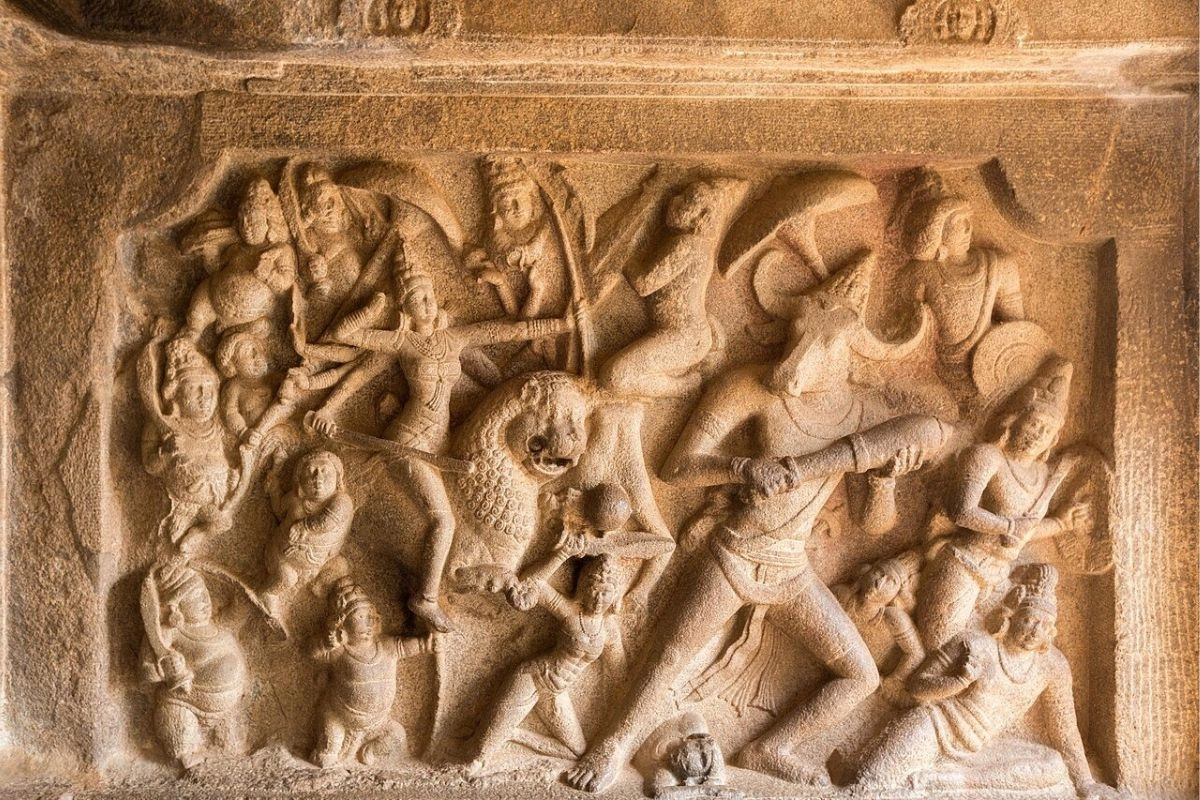
Mahishasuramardini, the Goddess riding into battle against the buffalo demon. Rock-cut relief, Mahabalipuram, seventh century.
Last month we spent our mornings with Sarada Devi. One evening in 1872, Sri Ramakrishna seated his young wife in the place of the Goddess at Dakshineswar and performed the full worship to her, with flowers and lamps and mantras, as he would have done to the image in the temple. She sat through it in a kind of trance, and when it was over she went back to her small room by the music tower and carried on with her life of cooking and looking after people. I kept thinking about that evening while preparing this issue, because the nine nights that begin on the 11th of October are really about the same recognition he had. The power that runs this universe is not far off in some heaven. It is sitting in front of us, and in us.
We usually call Navaratri the festival of the Goddess, which it is. But the word the tradition actually uses for her is Shakti, and that word means power, or energy. Anyone who has done even a few months of pranayama knows that yoga is essentially a way of working with energy, of gathering it, directing it and eventually letting it rise. The Nath tradition, which our Kendra comes from, has always said that this body is the temple and the Shakti is already inside it, waiting. So when we see the Devi being worshipped in a pandal or in a temple during these nine days, what is really being celebrated is the same energy that is moving our breath right now. The outer festival and the inner practice are describing one thing.
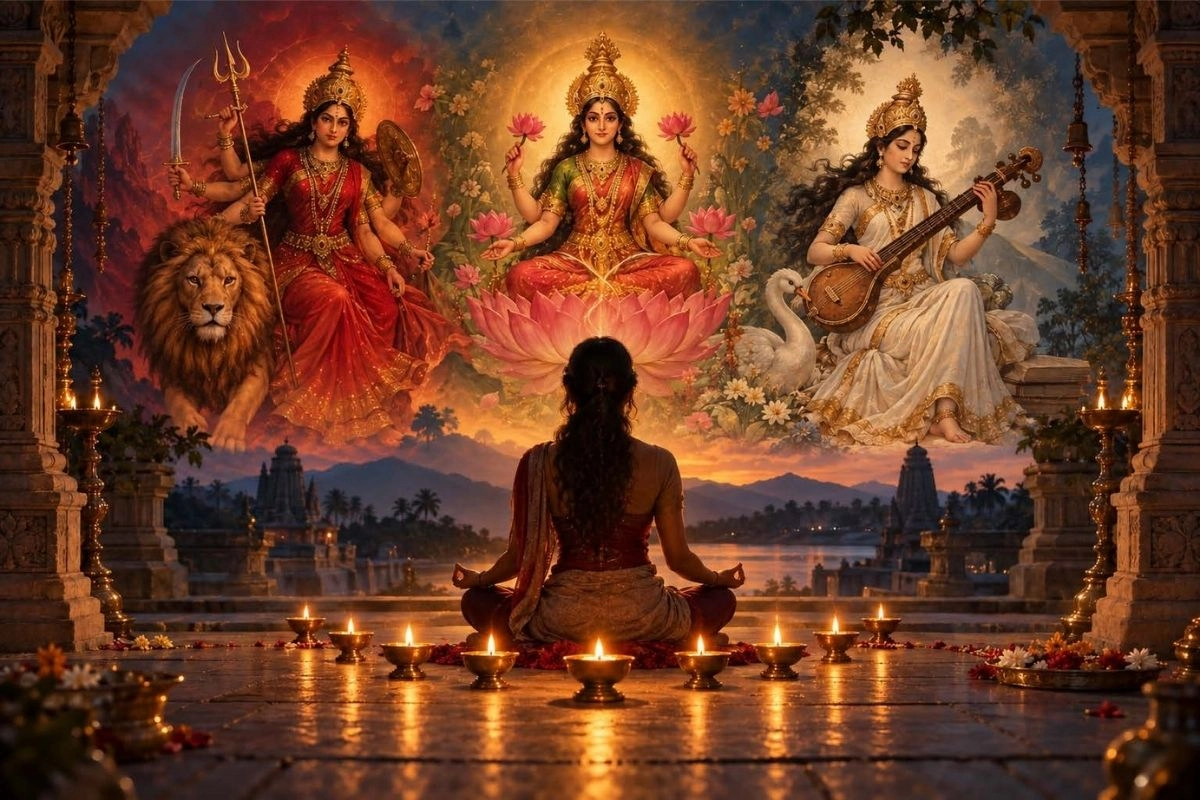
There is an old way of dividing the nine nights into three groups of three. The first three nights are given to Durga, the middle three to Lakshmi, and the last three to Saraswati. I find it useful to read this as a sequence rather than three separate festivals. Durga destroys, and what she destroys first is tamas, the heaviness and dullness in which no practice can begin. Lakshmi nourishes, and what she nourishes is our rajas, the restless energy that needs feeding and direction rather than suppression. Saraswati illumines, and she can only do that once the first two have done their work, because knowledge needs a mind that is both awake and quiet. Vijayadashami on the tenth day is the victory that comes at the end of that process. It is a victory over our own gunas, not over anybody else.
Sir has often said that the Devi is not a concept to be believed in. She is the energy by which we are breathing and thinking at this moment, and worship simply means recognising that. This month’s blog takes that idea into the ordinary decisions of the festival season, what we eat during the fast, what we buy, and how we spend the nine evenings. Our book review is of the Devi Mahatmyam, the text that is chanted through these nights in temples and homes across the country.
For our practice this month, I would suggest treating the nine nights as a small retreat conducted inside your normal life. Sit a little longer in your morning meditation than you usually do, keep the evenings quieter than the season would like you to, and let the days carry you from heaviness towards clarity in their own order.
Om Tat Sat.
Sri M Speaks
Talk with M
BLOG POST
Conscious Living: What We Take In During Navaratri
Every year around this time I notice the same contradiction, and I suspect many of you do too. Navaratri asks us to fast, to eat simply, to sleep early and wake before dawn for the puja. At the same time, the nine days of Navaratri have become the busiest shopping season before Diwali, the pandals get bigger every year, and in most neighbourhoods the loudspeakers are still going well past midnight. Both of these are called Navaratri. The one we end up living depends on a lot of small decisions we make through the nine days, mostly without thinking about them, and this month I want to look at those decisions.
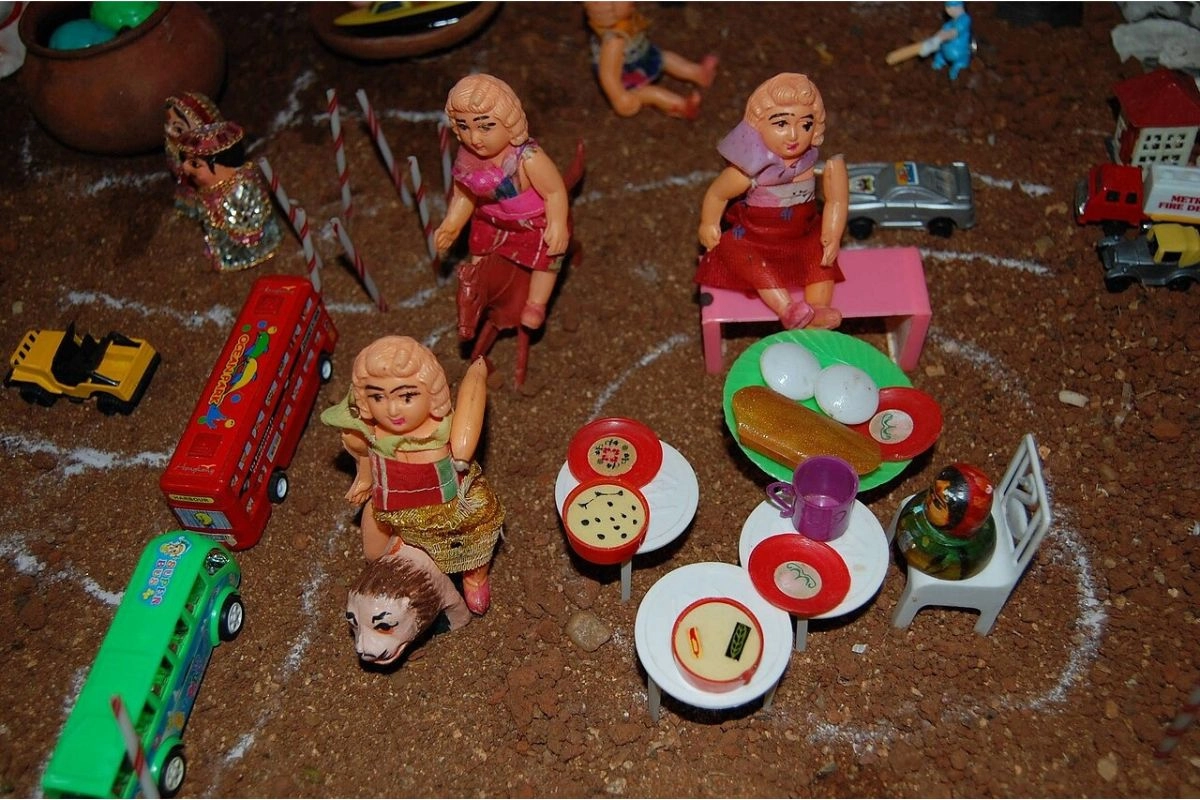
A golu display in a South Indian home during Navaratri
It helps to go back and ask what the fast was originally for. The texts do not treat fasting as a punishment, and they do not treat it as a way of collecting merit either. They treat it as a way of making the body light enough that the mind can be turned inward. Patanjali has a word for this turning, pratyahara, which means drawing the senses back from their objects, and he places it exactly in the middle of the eight limbs, between the outer practices of asana and pranayama and the inner ones of concentration and meditation. If you have ever eaten lightly for a few days, spoken a little less and stayed away from the usual stream of entertainment, you will have noticed that the mind settles more easily when you sit. That settling is the whole purpose of the discipline. The food rules, the early hours and the quiet were all meant to help a mind that is trying to sit down.
The Gita has a way of talking about food that I have always found more useful than any list of what is allowed and what is not. In the seventeenth chapter Krishna describes food by its effect on the mind rather than by any rule of purity. Sattvic food is fresh, mild and nourishing, and it leaves the body light and the mind clear. Rajasic food is very hot, very salty, very spicy or very sour, and it agitates. Tamasic food is stale, overcooked, reheated, and it dulls the mind. He goes on to say that the same three qualities show up in how we give, in how we worship, and in the kind of austerity we practise. A fast that is kept with pride, or kept so that people will notice it, is a rajasic fast however empty the plate.
This gives us a more honest test for the Navaratri table. Instead of asking whether sabudana is permitted or which flour is allowed, we can ask what the meal does to us an hour afterwards. A bowl of fruit and a glass of milk leave the body quiet and the evening meditation is easy. Breaking the same fast at a stall with a plate of deep-fried vada and a sweet lassi leaves the body heavy and the mind restless, and whatever the fast had built up during the day is gone by night. Nobody else is keeping count, but the mind keeps its own count and shows it to us the next morning when we try to sit.
Food is only the most obvious thing we consume. We also take things in through the eyes and the ears, and these days most of us take in more through the phone than through the mouth.
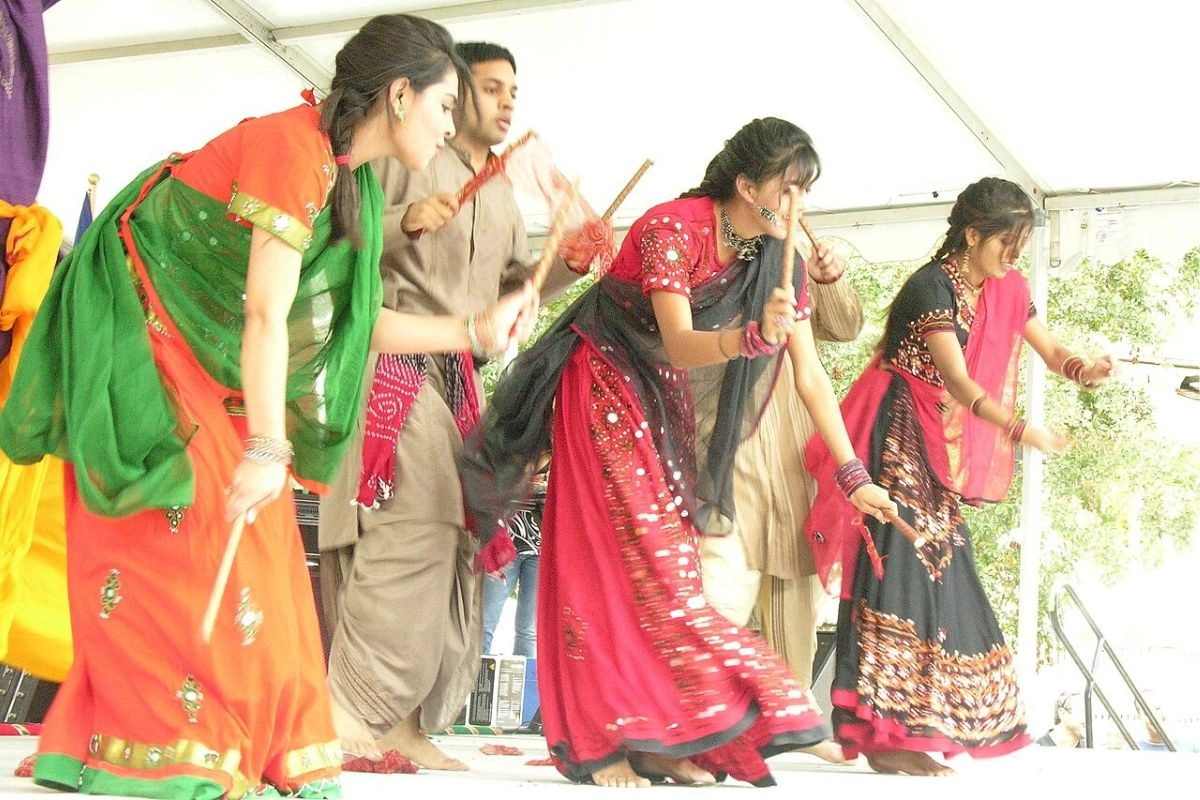
Garba during Navaratri
I want to be careful here, because there is nothing in our tradition against music and dance, and I would not want anyone to read this as a complaint against the festival. The garba and dandiya in Gujarat, the golu in Tamil homes with its steps of dolls and its evenings of visiting and singing, the Durga Puja pandals of Bengal with their extraordinary art and their crowds, the Dasara procession in Mysore, these are old, they are beautiful, and they have kept the Devi alive in places where the texts alone never could have. The only question for someone who is practising is one of proportion and attention. An evening of garba danced wholeheartedly, with the whole body and the whole mind in it, is a form of worship. The same evening spent half dancing and half filming yourself dancing, checking how the video came out between songs, is something else. The clothes are the same but the mind is somewhere else entirely.
Sarada Devi, whom we read last month, said something that applies here. She said the mind is everything, and that whatever we keep the mind on, that is what we become. If the nine days go in scrolling through other people’s Navaratri, the mind at the end of them will be full of other people’s Navaratri. If they go in reading the Devi Mahatmyam, or sitting with a lamp in the evening, or simply keeping a quieter house than usual, the mind at the end of them will carry that instead. It is not a complicated principle. It is just difficult to remember when the phone is in your hand.
Then there is what we buy. In most cities Navaratri has turned into a shopping season, and the nine colours assigned to the nine days have become nine occasions to buy something new. The older practice was much simpler. The colours were a way of remembering which form of the Devi was being honoured on which day, and people wore whatever they already had in that colour, a yellow sari from the cupboard, a green dupatta borrowed from a sister. Now the nine colours are mostly something the shops tell us about, usually with a discount attached.
Patanjali has a word for this too. Aparigraha is the last of the yamas and it is usually translated as non-hoarding, or non-grasping. It does not ask us to own nothing. It asks us to notice the grasping itself, the small movement of the mind reaching for one more thing, and to check whether the thing is actually needed or whether the reaching has simply become a habit that the market has learned to set off. It is a strange thing, when you think about it, that a festival of the Divine Mother should have become one of the most effective advertising seasons in the year. A golu doll bought because it is lovely and will come out of its newspaper every October for the next twenty years is one kind of purchase. Twelve new decorations bought because the neighbour’s display was bigger is a different kind, and the difference has nothing to do with how much was spent. It has to do with which part of us was doing the buying.
Sir has said more than once that the Devi is the energy behind every movement in our lives, and that worshipping her means bringing that energy under some direction instead of letting it be pulled about by every passing want. Looked at that way, the shopping question stops being a moral one. It becomes a practical question about where our energy is going during a season that is supposed to be about gathering it. Whatever goes into acquiring is not available for the practice, and nine days pass quickly.
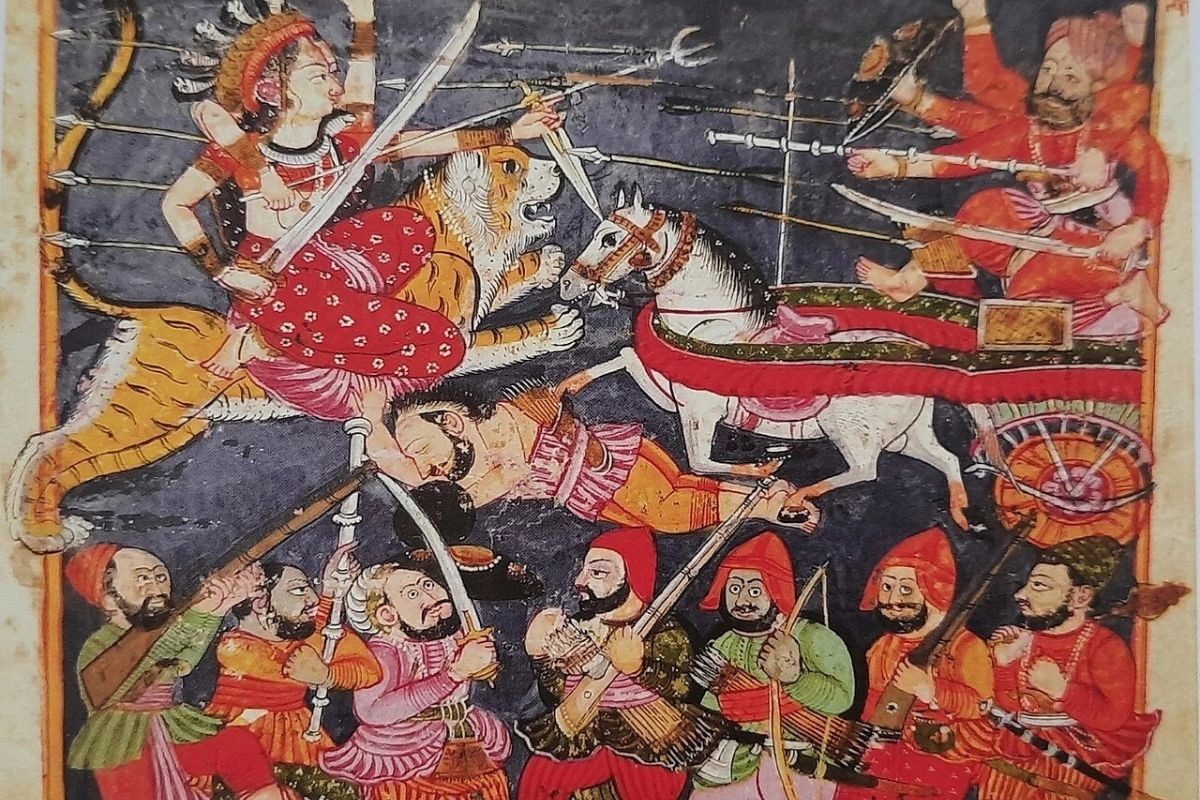
The Goddess in battle, from a dispersed manuscript of the Devi Mahatmya
Here is the practice for this month.
Keep a sattvic table for the nine days, and keep it simple. Fresh food, a little less of it than usual, and the evening meal earlier than usual. Do not make the fast into a performance or a project. If the family eats together, let the simpler meal be the one everybody shares, rather than a separate rule you follow alone at the table.
For the evenings, decide before the festival begins how many of the nine you will give to the public celebrations, and then give those evenings fully, with the phone in your pocket. Keep the other evenings at home. Light a lamp at dusk. Read a chapter of the Devi Mahatmyam if you have a copy, or sit with a mantra of the Devi for twenty minutes before dinner. On the last three nights, which belong to Saraswati, take down a book that has been waiting on the shelf and read it slowly, as an offering rather than a task.
For the buying, try one small discipline. Before anything is purchased for the festival, let one night pass between wanting it and buying it. Most of the wanting will not survive till morning. Whatever does is probably something you actually need.
Through all of this, keep your morning meditation as the fixed point. The food, the evenings and the purchases are only the outer limbs, and the sitting is what they are for. By Vijayadashami, if even some of this has been kept, the victory the day is named after will be a little closer than it was on the first night, and it will have been won in the places where our real battles usually happen, at the dining table, at the shop counter, and on the sofa after dinner with the phone within reach.
Om Tat Sat.
BOOK REVIEW
Devi Mahatmyam, translated by Swami Jagadiswarananda
Sri Ramakrishna Math, Chennai. Sanskrit text with English translation, about 230 pages.
Most of us who grew up in Hindu homes have heard the Devi Mahatmyam being chanted during Navaratri, in a temple or on a recording playing in somebody’s living room, without ever having read it as a book. I was in that position for years. The sound of it was familiar and the content was a blur of battles and names. When I finally sat down with this edition one Navaratri, reading a few chapters each night, I was surprised at how much of it spoke directly to the practice we do every morning. So this month I want to recommend the text itself, in the edition that I think is the best one to begin with.
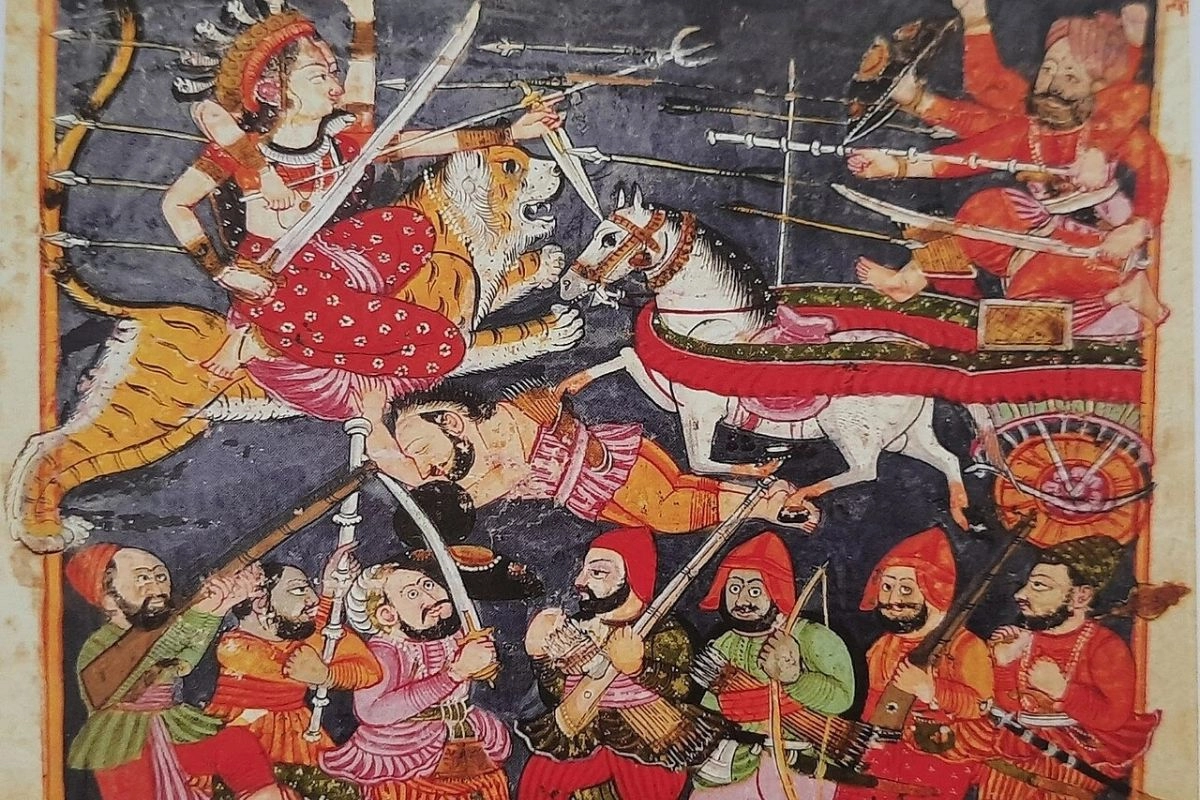
Folio from a Devi Mahatmya manuscript showing the Goddess slaying an asura. West Bengal, seventeenth century.
The Devi Mahatmyam is a section of the Markandeya Purana, thirteen chapters and roughly seven hundred verses, which is why it is also called the Durga Saptashati, or simply the Chandi in Bengal. It is told as a story inside a story. A king called Suratha has lost his kingdom, first to enemies and then to his own ministers, who helped themselves to the treasury while he was away. A merchant called Samadhi has been thrown out of his home by his wife and sons, who wanted his money and not him. The two men meet in a forest and discover that they share the same problem. The king cannot stop worrying about the kingdom that betrayed him. The merchant cannot stop loving the family that robbed him. Why, they ask each other, does the mind go on clinging to the very things that have hurt it? They take the question to a sage named Medhas, and his answer takes up the remaining twelve chapters. The clinging, he tells them, is the work of Mahamaya, the great power that keeps the world going, and the only way out of her is to know her. Then he tells them who she is, through three long stories.
These three stories are called the three charitas, and if you are keeping the nine nights you will notice straight away that they match the three sets of three. In the first, the Devi is Vishnu’s own sleep, the yoganidra that has to be coaxed out of his eyes before he can wake and deal with two demons that have been born from the wax in his ears. In the second, the gods have been beaten by the buffalo demon Mahishasura and driven out of heaven, and in their anger a light pours out of each of them, and the lights join and become a woman. Each god hands her his own weapon and she rides out on a lion to meet the demon. In the third, which is the longest, two brothers called Shumbha and Nishumbha send the Devi a proposal of marriage. She replies that she made a foolish vow long ago to marry only the man who defeats her in battle, and she then defeats every general they send. Partway through, a dark form springs out of her forehead, Kali, who deals with the demon Raktabija by swallowing his blood before it can fall to the ground, since every drop that touched the earth was becoming a new demon.
As stories these are very good, and children love them. But the yogic tradition has always read them as a description of what happens inside us, and once you read them that way they become something else. Mahishasura is tamas, the heaviness that the gods cannot defeat one by one because a divided mind cannot defeat anything. Raktabija is the thought that doubles every time you cut it, which anyone who has sat for twenty minutes will recognise. The woman made of the gathered light of all the gods is the mind that has finally stopped scattering itself. The book does not say any of this in so many words. It just tells the stories and leaves the reader to notice.
In between the battles come the hymns, and I think these are the real reason the text has lasted fifteen hundred years. The fourth chapter has the gods praising the Devi after Mahishasura has fallen. The fifth chapter has the long litany that most of us know from the chanting, where she is saluted as the one who lives in all beings as consciousness, as intelligence, as sleep, as hunger, as forgiveness, as peace, as error, and as the mother. The eleventh has the Narayani Stuti, in which the gods tell her that she creates the world, she maintains it, and at the end everything dissolves back into her. The theology behind all of this is very simple. There is one power, we call it Mother, and everything we meet is a face of her, the demons included, our own confusion included.
What I like about Swami Jagadiswarananda’s edition is that it gets out of the way. The Sanskrit is given verse by verse with the English directly under it, so if you have even a little Sanskrit you can follow the chanting and check what is being said. The translation is plain and does not try to be poetry. The introduction is short, explains how the text is used in ritual, describes the preliminary and closing hymns that are chanted along with it, and gives the traditional way of spreading the chapters over the nine nights. There is no long commentary and no attempt to persuade you of anything. It simply presents the text and trusts you with it.
If I have a reservation, it is the same restraint. Someone who wants the esoteric reading, where the three charitas are the three granthis in the subtle body and each battle is a stage in the rising of the kundalini, will not find it spelled out here. The edition gives hints and no more. On reflection I think that is the right order to meet the text in. The story has to be read first and allowed to sit for a year or two. The inner reading tends to arrive by itself, in my experience somewhere around the third Navaratri.
I want to end with how the frame story ends, because it is worth carrying through the festival. After hearing all of this, the king and the merchant go to a riverbank and worship the Devi for three years, and when she finally appears and offers each of them a boon, they ask for different things. The king asks for his kingdom back, and she gives it to him. The merchant asks only for the knowledge that will free him from his attachment, and she gives him that. The text does not say that one of them chose better than the other. It says only that she gives what is asked for, and leaves us to think about what we would ask.
For anyone keeping the nine nights this year, I would suggest chapters one to four over the first three nights, five to eight over the middle three, and nine to thirteen over the last three, with the frame story read once more on Vijayadashami.
YOGA GUIDE
Siddhasana (The Accomplished Pose)

Siddhasana is one of the oldest yoga asanas and is mentioned in several early yoga texts, including the 10th century Goraksha Sataka and the 15th century Hatha Yoga Pradipika. In these texts, Siddhasana is described as one of the most important asanas, along with the Padmasana (lotus pose), and is said to open the way to liberation. It is also said to be the best asana for meditation and breathing exercises.
The asana is mentioned in the Hatha Yoga Pradipika 1.37– 45 calls Siddhasana “the king of all asanas” and “the opening of the door of salvation,” stating that the pose “cleanses the impurities of 72,000 Nadis,” or subtle bodily channels.
Benefits–
This pose aids a naturally elongated spine promoting optimal airflow and helping deep rhythmic breathing.
It helps maintain celibacy. Regular practice aids channel sexual energy and promotes self-control and balance.
Directs energy from the lower psychic centres upward through the spine, stimulating the brain and calming the nervous system.
Balances reproductive system and blood pressure
JOURNEY OF A SATSANGI
Journey of a Satsangi – Part 9: Teaching at the Peepal Grove School
Hello and welcome to Part 9 of the Journey of a Satsangis! In the previous episode, I arrived at the Peepal Grove School (PGS) and shared some of my experiences of living on the campus, along with a few of the memories that have stayed with me over the years. For those who may be joining the story here, Part 1 of the journey began in the February edition of the BYK newsletter, with subsequent chapters continuing in later editions. Each part traces a different stage of the journey and I’m grateful to be able to share my experiences here with you.
As mentioned in the previous episode, I will be focusing each of the subsequent episodes on a particular aspect of my experience at PGS. In this episode, I will share my experiences with the students at the school, as well as the insights I gained while teaching chess and tutoring mathematics at the school.

The students raising the school flag on the sports field during their athletics day competitions
The school catered to students from Grade 4 through Grade 12, with the students divided into two groups: juniors, from Grades 4 to 8, and seniors, from Grades 9 to 12. The students were also organized into separate dormitories of 12 to 16 students based on gender and age group, with junior and senior boys and girls housed separately. Each dormitory was supervised by a teacher who served as the house parent, responsible for the students’ well-being and ensuring that they followed the school’s rules and expectations.
Life for the students at PGS was quite busy. Their day began at 6:30 a.m. with morning activities such as bird watching, yoga, sports, and martial arts, followed by breakfast and then classes and/or assemblies beginning at 8:00 a.m. Classes continued until 12:30 p.m., when the students had lunch and then a break until 2:30 p.m. to escape the brunt of the afternoon heat.
Classes resumed at 2:30 p.m. and continued until 4:30 p.m., after which the students headed off for afternoon sports, including football (or soccer), tennis, badminton, cricket, and basketball. After sports, they had dinner before returning to class from 8:00 to 9:00 p.m. for homework and tests.
This schedule ran from Monday through Saturday and sometimes included remedial classes on Sundays. Needless to say, it was a pretty full schedule for these students!
The students’ days were so busy because PGS’s mission was to develop well-rounded individuals. In addition to their regular academic studies, the students were given opportunities to learn art, music and dance, study a second—and sometimes even a third—language, including Sanskrit and Hindi, participate in sports, and take part in skits, presentations, and other creative activities. The school placed as much emphasis on developing the students’ talents, confidence, and character as it did on their academic education.
Another key aspect of the school was that students were not given regular access to smartphones or the internet. They were allowed to use the phone only once a week to call their parents, while internet access was restricted to school-related work. I found this particularly interesting given how dependent students in the West have become on smartphones and the internet.
With such a full curriculum of academics and extracurricular activities, it was amazing to see the students flourish and grow. They developed an earnest curiosity about the world around them while learning the importance of teamwork, discipline, and healthy competition. They also developed an appreciation for nature through their daily exposure to the diverse flora and fauna on the campus and in the surrounding areas.
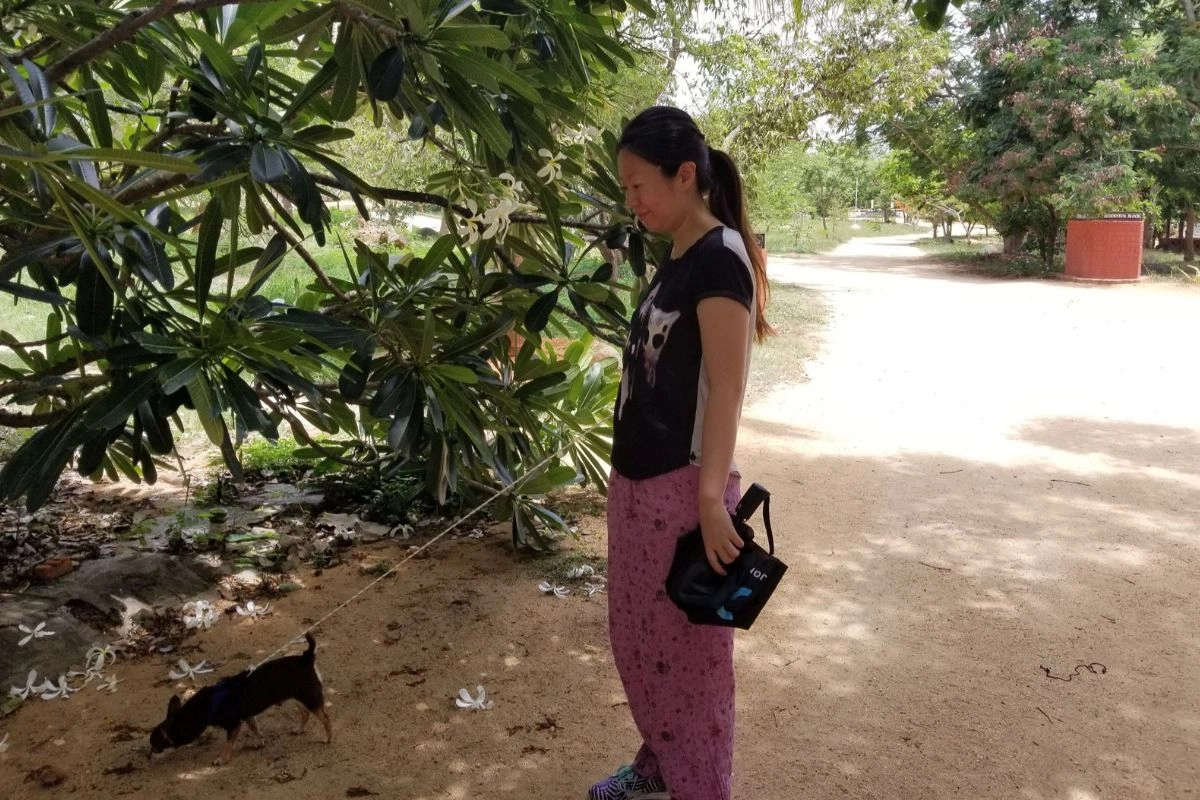
Diane walking monkey on the campus grounds of PGS. Monkey is wondering about these strange smells
This isn’t to say that the transition to school life was easy for all the students. I saw some of the new students crying and missing their homes and parents during their first couple of weeks at the school. In almost every case, however, the tears eventually stopped as they adjusted to their new surroundings and settled into their new routine.
What was both amazing and slightly amusing was seeing some of those same students crying again at the end of the term—this time because they didn’t want to leave the school!
My first task at the school was to start a chess club. I created a sign-up sheet to gauge the students’ level of interest. Initially, I thought it would be great if 10 or 12 students out of the approximately 130 students at the school wanted to learn chess. To my surprise, almost 50 students ended up signing up for the club!
I suspect about half of them were genuinely interested in learning chess, while the other half were probably just happy for the novelty and a change of pace for a couple hours each week. I think it also helped that I brought Monkey along to the lessons, who had quickly become a celebrity among the students!
The school had only four chess sets at the time, so I had the school purchase another eight to accommodate the number of students who had signed up. Even with the additional sets, I ended up splitting the club into beginner and intermediate/advanced groups to help manage the numbers. This also allowed me to tailor the lessons more effectively to the different skill levels of the students.
It had been quite some time since I had played chess competitively in high school (almost 30 years) so I had to spend some time brushing up on my skills. Having so many enthusiastic students eager to learn actually made it quite enjoyable for me to get back into the game and refresh my knowledge of chess tactics and strategies. A couple of the students, in particular, were very quick to pick up the tactics, and one of them eventually managed to beat me in a match at the end of the term, much to his delight—and, I have to admit, to my own satisfaction, although my ego was slightly bruised in the process.

The PGS dining hall was transformed into a chess arena, filled with the quiet intensity of students deep in thought. You could almost hear the crackle of mental energy in the air!
We even had the opportunity to hold a chess tournament where the students could test their skills against one another. It was a fun way for them to put what they had learned in class into practice, while enjoying some friendly competition with their fellow students.
Besides running the chess club, I was also asked to tutor mathematics for some Grade 8 to 10 students who needed extra help or had learning difficulties. I set up weekly office hours where students could sign up to spend time with me for additional support. I also attended the mathematics classes for each grade a couple of times a week, sitting with the students while their teacher conducted the lesson so that I could help them with any questions or difficulties they had during class.
I had some experience tutoring mathematics during high school and university, and those experiences definitely helped me in this role. It was rewarding to be able to draw on those earlier experiences and use them to help students who needed a little extra support.
One insight I gained from observing both the students who struggled with mathematics and those who excelled was that, despite all the differences in their personalities and abilities, there seemed to be one important underlying difference: the students who performed well generally believed that they were good at math, while those who struggled often did not believe they were capable of doing well.
I felt that this belief in themselves gave the students who were good at math the perseverance to keep working through difficult problems. They were more willing to try different approaches, make mistakes, and keep going when they didn’t immediately know the answer. On the other hand, the students who struggled often lacked that same confidence in their abilities. They would sometimes give up on a problem after only a few seconds and spend much of their time chastising themselves or lamenting about not being able to solve the problem..

Diane inside the library at PGS
Over time, the students who excelled in math early on built up the mental tools and problem-solving skills needed to tackle increasingly difficult problems. In contrast, those who lacked confidence in their abilities often did not give themselves the opportunity to develop those same skills. As a result, what may have started as only a slight difference in ability gradually became a much wider gap between the students.
It seemed to me that this created a self-reinforcing cycle: the students who believed they were good at math kept trying, which allowed them to develop their skills further, while those who lacked confidence gave up more easily and therefore had fewer opportunities to build those same skills.
This insight helped me formalize my approach to tutoring mathematics. I came to believe that there were three important steps to helping a student who lacked confidence in their mathematical abilities.
I needed to show the student that I was not there to judge them or their ability. I had to earn their trust and demonstrate that I genuinely had their best interests in mind. This could take several weeks or even months, but without that trust, it was difficult to make meaningful progress.
I wanted to help the student understand that struggling with mathematics (or with any subject or activity for that matter) was not the result of some inherent defect or inability on their part. More importantly, I wanted to help them develop a belief in themselves and trust that they were capable of learning and improving.
Finally, I needed to create a systematic approach to help them build the mental tools and problem-solving skills they were missing. By starting at an appropriate level and gradually increasing the difficulty, they could experience small successes along the way. These successes would, in turn, reinforce their belief in themselves and encourage them to keep trying when they encountered more difficult problems.
In many ways, I came to see tutoring as being about much more than teaching mathematics. It was about helping students develop the confidence and perseverance to believe that they could learn. The challenge, however, is that belief can be a very fickle thing, and much of the time, it is not entirely within our own control. Our beliefs are shaped by our environment, the results we have experienced from our previous actions, and, perhaps most importantly, the belief that others have in us.
It has been one of the most rewarding experiences of my life to work with the students at PGS and help them overcome some of their previous conditioning and learn to believe in themselves. I say “students,” but in reality, we are all students. I believe that if a teacher is not also learning from their students, then they are not truly teachers. These experiences gave me a deeper appreciation of the power of faith and belief and how it shapes our ability to learn.
To be continued…
Ayurvedic Wisdom
Upavasa – Art of Fasting
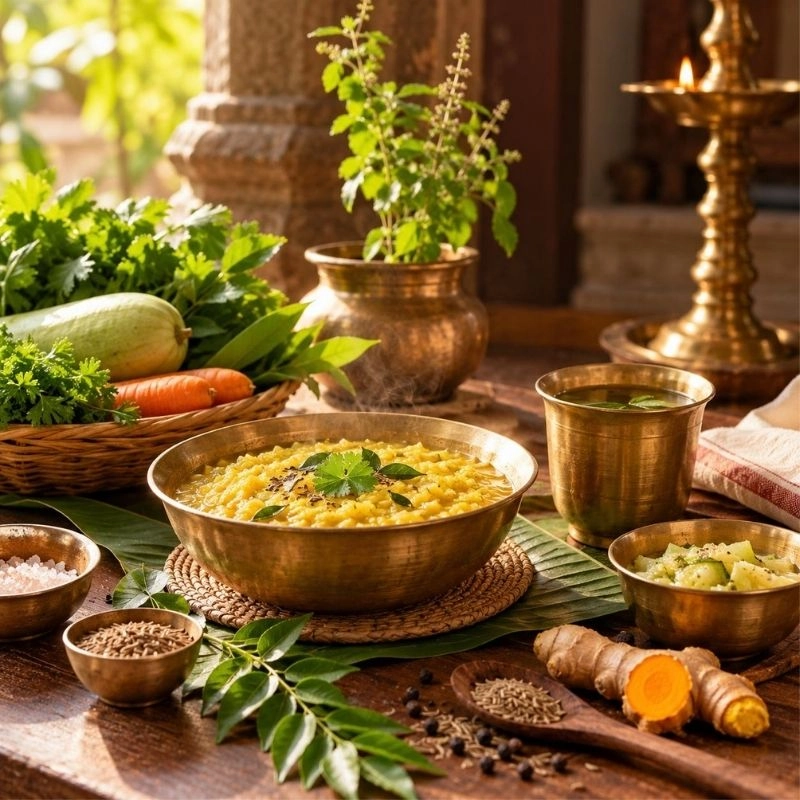
In Ayurveda, fasting is known as Upavasa and is classified as a core component of Langhana (depletion or to lighten therapy). Rather than focusing on extreme starvation, the Ayurvedic perspective views fasting as a tool to kindle Agni (the metabolic digestive fire) and eliminate Ama (toxic, undigested metabolic waste).
Core Ayurvedic Concepts of Fasting
- Kindling the Digestive Fire: When you stop eating, your digestive system rests. The internal fire (Agni) burns away accumulated toxins (Ama) instead of processing new food.
- Mind -Body Rejuvenation According to classical texts like the Charaka Samhita, fasting works on three distinct tiers: rational/physical healing, psychological clearing, and spiritual development.
- Moderation is Key: Ayurveda strongly warns against excessive or prolonged fasting, which can severely weaken Agni, aggravate Vata dosha, and deplete bodily tissues (Dhatus).
Fasting Customization by Dosha (Constitution)
Ayurveda emphasizes that fasting is not one-size-fits-all. It must be tailored to an individual’s specific constitution (Dosha):
- Vata Dosha Fasting – Fasting Style:
Gentle and short. Avoid strict water-only or zero-food fasts.- Duration: A gentle 12-hour overnight fast (e.g., finishing dinner early and eating breakfast around 8:00 AM). Do not fast for more than 1 to 2 days.
- Best Foods / Break-Fast:
Warm, moist, and grounding meals like kitchadi (rice and mung dal cooked with ghee and mild spices) or sweet, vata-pacifying juices like mango or orange. Sip warming ginger-fennel tea.
- Pitta Dosha Fasting
- Fasting Style:
Moderate; never skip water or push into aggressive starvation, or you may experience heartburn, dizziness, or anger. - Duration:
A 14- to 16-hour fast (ending by or around noon). - Best Foods / Break-Fast:
Cooling and hydrating options like coconut water, diluted pomegranate or grape juice, sweet fruit smoothies, or cooling
kitchadi with fennel tea.
- Fasting Style:
- Kapha Dosha Fasting
- Fasting Style:
Can handle the deepest and most regular fasts out of all three doshas due to abundant internal stamina. - Duration:
A 16- to 18-hour intermittent fast or a weekly liquid/water-friendly fast. - Best Foods / Break-Fast:
Light, warm, and stimulating items. Hot water with lemon and honey, light vegetable juices, or spiced legume soups with warming spices like
ginger, black pepper, and trikatu.
- Fasting Style:
General Ayurvedic Rules for All Doshas
- Avoid Water-Only Extremes: Absolute starvation is rarely prescribed in classical Ayurveda except under strict Panchakarma supervision.
- Respect Agni (Digestive Fire): Always break your fast slowly with warm, easily digestible foods rather than heavy, cold, or oily meals.
- Contraindications: Fasting is not recommended for pregnant or breastfeeding women, children, the elderly, individuals with eating disorders, or those dealing with severe tissue depletion or chronic illness.
Classical Signs of a Successful Fast
According to Ayurvedic clinical reviews, a fast is considered successful when the body exhibits signs of proper purification. You should monitor yourself for these positive indicators:
- Clarity of the senses and a clear mind
- A clean tongue (the white coating of Ama disappears)
- Return of genuine hunger and thirst
- Feeling light, energetic, and free of bodily stiffness
- Easy elimination of gas, urine, and stool
COMMUNITY COLUMN
The Whispers of Devi: Awakening the Inner Shakti during Navaratri
A Guide to Reclaiming the Regal Sovereignty and Stillness of the Sacred Feminine
Written beneath the luminous canopy of Navaratri, when the cosmos itself aligns to celebrate the Divine Feminine, this piece is a sacred invitation to the modern woman. It is a call to step off the modern battleground of exhausting friction, to silence the noise of fighting for validation, and to gently awaken the boundless Shakti sleeping within the sanctuary of her own soul. Navaratri is not merely a festival of external rituals; it is a profound alchemy of the spirit. Across these nine sacred nights, a woman journeys through the fierce purification of Durga, blossoms into the radiant grace of Lakshmi, and dissolves into the luminous, silent wisdom of Saraswati—shifting her entire being from the chaotic ‘fight mode’ of survival into the majestic stillness of ‘Shakti mode.’
By re-tracing the ancient, starlit footprints of the Vedic Rishikas like Gargi and Maitreyi, and breathing in the cosmic truth of the Devi Suktam, we remember a time when women did not beg for a seat at the table. They were the very foundation upon which existence was woven—reigning as Samrajni, the sovereign queens of their universe. This text serves as a modern compass for the feminine soul. It explores how to transform your home into a vibrant temple of peace, trade reactive arguments for unshakeable internal dignity (Sthirata), and master the art of magnetic complementarity. You are not incomplete, and you do not need to fight to be equal. Step inward, breathe in your divinity, and remember: you are the cosmic womb, the anchor of the home, and the very breath of creation.
The Sovereign Path: Navaratri’s Three Stages of Inner Metamorphosis
The nine nights of Navaratri provide a systematic, psychological, and energetic framework to rebuild your personal authority from the inside out:
- Days 1–3: The Fire of Maa Durga (Strength & Purification): Tap into your inner warrior to root out fear, people-pleasing tendencies, and self-doubt. Set strict personal boundaries, challenge limiting habits, and protect your emotional space.
- Days 4–6: The Grace of Maa Lakshmi (Power & Abundance): Cultivate complete capability and gratitude. Lakshmi represents the fluid flow of spiritual, mental, and physical resources. Nurture your unique skills, practice absolute elegance under pressure, and enrich your surrounding community.
- Days 7–9: The Light of Maa Saraswati (Wisdom & Self-Realization): Channel the goddess of knowledge by dedicating yourself to lifelong learning, creative mastery, and spiritual truths. Practice silent meditation to clear mental clutter and tap into pure intuition.
Echoes of Ancient Royalty: Walking with the Great Vedic Rishikas
Ancient Vedic women did not spend their lives fighting for validation; they operated from a state of total wholeness (Purnatva). By keeping these ancient ladies as your foundational role models, you transcend modern social exhaustion:
- Gargi Vachaknavi (Intellectual Sovereignty): Renowned for challenging the top sages of her time in public debates with razor-sharp logic and absolute composure. To apply her power, trade screaming matches or nagging for factual excellence, a cultured mind, and a calm voice that commands the room to go silent.
- Maitreyi (Spiritual Centeredness): Famously rejected vast material fortunes because she realized fleeting material trends could not grant her immortality or inner peace. Break free from the validation trap of consumerism; anchor your worth in your internal depth rather than external approval.
- Arundhati (Magnetic Complementarity): In Vedic astronomy, the stars of the sage Vashistha and Arundhati do not have one revolving around the other; they revolve around each other in perfect, non-hierarchical balance. Stop treating your marriage like a score-keeping corporate competition. Step into your distinct domain of genius—vision, emotional anchoring, and profound intuition—and let your partner lead in areas of external execution.
The Alchemy of Surrender: Why Liberation Favors the Feminine Design
In esoteric yoga, the feminine biological and energetic system possesses an innate, natural blueprint for rapid liberation (Moksha). While the masculine energy (Pingala) is assertive and analytical—often building a rigid ego that must later be forcefully broken down—the feminine energy (Ida) is inherently receptive, intuitive, and fluid.
Enlightenment is ultimately an act of complete surrender (Prapatti), dissolving the individual self into the cosmic ocean. Furthermore, the vast emotional depth of a woman is not an obstacle; it is the ultimate fuel. When turned inward toward the divine, raw emotion instantly transmutes into intense devotion (Bhkati), leading to spontaneous, lightning-fast liberation as demonstrated by historical mystics like Andal, Akka Mahadevi, and Anandamayi Ma.
Sacred Geography: Crafting an Energetically Vibrant Sanctuary
Your home is a physical manifestation of your own aura. By consciously managing its subtle energy, you create an unshakeable fortress that automatically centers you:
- Space Clearing: Monthly, wipe entryways and floors with rock salt water to absorb environmental stress. Shatter stagnant energies in deep corners by ringing a brass bell or playing continuous Vedic chants at a low volume.
- The Gateway Filter: Keep your main doorway (Mahadwara) brilliantly lit and clean. Burn pure Bhimseni camphor every evening to instantly dissolve heavy atmospheric imprints.
- Elemental Alignment: Keep the Northeast zone (Water) light and open for your altar or meditation mat. Keep the Southeast corner (Fire) active with your kitchen or a daily burning diya. Ground your relationships by keeping heavy furniture or crystals in the Southwest (Earth) master bedroom.
- The Power Source: Maintain a dedicated altar facing East or North. Keep an Intention Jar (Kalash) filled with clean water on your altar to absorb the positive vibrations of your prayers, and use it daily to water your household plants.
From Fight Mode to Shakti Mode: The Physical and Experiential Metamorphosis
When a woman systematically steps out of reactive ‘fight mode’ and fully invokes the divine Devi Shakti within herself, she undergoes a tangible biological and experiential shift:
- Coolness at the Brow (Ajna Activation): A pleasant, cool pressure forms between the eyebrows, signaling that the exhausting, analytical overthinking brain has quieted down to make way for crystal-clear intuition.
- Warm Expansion of the Heart (Anahata Space): A warm, radiant spaciousness develops in the chest, melting away the defensive knots of anxiety and introducing an unshakeable sense of universal safety (Abhaya).
- A Rooted Spine (Muladhara Stability): The posture naturally straightens and feels immovable. You become the calm eye of the storm—a stable banyan tree around which the chaotic moods of your family or workplace safely de-escalate.
- Effortless Magnetism (Akarshana): You stop begging, nagging, or aggressively pushing for respect. You move, breathe, and speak with deliberate, slow weight (Vak). Your household unconsciously adjusts to your high spiritual vibration, yielding to your vision without a single conflict.
The ‘Shakti Bhava’ Ritual: A Daily Practice for the Sovereign Woman
Whenever you feel drained by modern multitasking or household friction, dedicate 15 minutes to this restorative meditation:
- The Posture of the Sovereign: Sit facing East or North with a straight, relaxed spine. Place your left hand open on your lap facing upwards (Receptivity) and your right hand over your heart center (Inner Power). Close your eyes and drop your shoulders.
- The Dissolution of Cloaks: Mentally shed your daily roles—the worker, the chore manager, the defending spouse. Breathe deeply and state: ‘I am not my responsibilities; I am not this exhaustion.’ Focus
on the dark, silent space of the inner cosmic womb. - The Navel Activation: Visualize a brilliant speck of golden-red light at your navel. As you inhale, draw it up to your heart and let it expand into a radiant sun enveloping your body. Mentally chant the seed vibration ‘DUM‘ (Durga’s protection) or ‘HREEM‘ (Cosmic Shakti) with every breath.
- The Sovereign Return: Before opening your eyes, lock in your state with the silent command: ‘I do not step back into the battle; I step into my temple. I am the center, and the world moves around me.’
By shifting her gaze from external battles to internal sovereignty, the modern woman ceases to fight for a fragile equality.
She awakens as the unshakeable Shakti—the sacred womb, the eternal anchor, and the very foundation upon which creation rests.
Student’s contributions
Poem for the Divine Mother
# O Ma,
You are the Unconditional Love, the Para, the Eternal, the Beyond.
You created consciousness and the OM.
From yourself, you carved every atom, every rock, all worlds,
and everything within them.
Yet, you are Poorna, eternally complete in yourself.
You reside in all creation in the form of love.
You are the Mother who gives
and teaches us the grace of giving Seva.
You watch over us in Jagran, Swapna, Susupti, and Turiya.
You are the protector of the innocent
and the guide of the sages.
You teach us to love our brothers and sisters,
our fellow beings, and all of creation.
O Ma, you are the giver of all that is
and the essence of its identity.
You make the sun shine, the wind blow, and the rain fall.
You manifest as Maha Kali, Maha Saraswati, and Maha Lakshmi.
Through Shiva, Vishnu, and Brahma,
You awaken creation
and express yourself in countless forms.
I bow down to You,
Mother, the Eternal Bliss.
—
What are we without You?
A child lost in Samsara,
a leaf carried by the wind,
a sailor lost at sea,
a Jiva wandering without knowing its true nature.
You are the origin of all that is,
the source of all opposites,
yet no paradoxes exist within you.
You pervade the pure and impure, the true and untrue,
yet remain Bhavatita, beyond all duality and becoming.
You are the light that illuminates the world
and the darkness that blankets the nights.
You are knowledge and ignorance at once,
yet neither can fully describe you.
You are every taste, sweet and sour,
yet no tongue can describe you.
All Devas and Asuras are your children;
all worship you in some form.
And you bless them all,
some with boons, some with liberation.
I bow down to you,
the universal Mother.
—
O Mother, sometimes I feel your presence around me,
yet I cannot see you. I cannot hear you.
And if I could hear you,
how could I describe you?
You are sound itself,
the sacred source of every word,
yet no word can ever capture you.
You are the unfathomable, the unimaginable,
the omniscient, the unadulterated One.
You are the One and None, the true Love, the Sunya,
the Bindu, the Omkara, Satyam, Ekam.
O dear Mother, you are the peace we experience in our breath,
in Chant, in OM, in Seva, or just by listening to our Guru.
You are the peace experienced in sweet food, in Sheetal Jal, or just during a gentle walk.
You radiate your peace through loving people and their Satsangas.
You are the peace we feel when moving away from fear or negativity.
Sahastra naman to the ever-peaceful, Param Prem Rupini Mother.
—
O Ma, you nurture and sustain us at the Muladhara.
You are the passion of Swadhisthana,
the warmth of the Manipura,
the tenderness of the Anahata Chakra,
the truth of the Vishuddhi Chakra,
and the wisdom of the Ajna Chakra.
You are the Inner Beauty,
the Healing, the Universal Energy,
the spiritual connection of the Sahasrara Chakra.
You are the origin and intention of all Kriyas, all emotions, thoughts,
intuitions, actions, all experiences, and all desires.
You are the slayer of ego (MahisaSura),
the guide on the path of truth
and prized Love at the end of it all.
Without you, we wander in Avidya as confused souls,
with bodies and minds, yet with disconnected,
disillusioned, discordant hearts,
and a longing whose source we do not know.
Guide us, O Mother. Show us the way,
O ever-compassionate One.
You are our companion,
ever-present, always by our side.
Yet, I struggle to see you
and remember you in my daily life.
Guide me to see the reality
where your Love shines brightly upon us,
where you hold us deep within your tender heart
and cradle us in your caring hands.
I plead with you to free us from this misery, O Mother.
Love us until we awaken and learn to love you back.
I prostrate before you, O Mother of All.
Through you, may we know that LOVE is our saviour,
our true salvation.
Love be our path to liberation, our destiny, our way.
For Love is the eternal truth.
Love is all that is.
Love is thee and thou art love.
Descend into my being, O Mother.
Change and transform us
into a vessel emptied of the Kleshas —
Avidya, Asmita, Raga, Dvesha, and Abhinivesha.
Fill us with eternal bliss.
Fill us with Love and Light.
Fill us with tears; fill us so that we may become one.
Om Matre Namah.
TESTIMONIALS
Testimonial – Antar Mouna Workshop
I LOVED the wokshop on Antar Mouna. Dr. Shubha has such an amazing way to explain things. The example of water in a river flows only one way and never comes back was an ahha moment for me and i think about it multiple times a day, trying to apply it to my everyday situations and experiences. I want to study the book i have on Patanjali Yoga and review the notes i made during the workshop so that i can practice fully what she taught us.
I have done the Mudras workshop with her and would love to do it again if it is offered. I look forward to many, many, many more workshops by Dr. Shubha.
Geeta Betrabe
Upcoming Courses & Retreats

Thank you for reading
In this issue of Yogavidya, we have:
- Navaratri from the Yogic Lens
- Sri M Speaks
- Talk with M
- Conscious Living: What We Take In During Navaratri
- Devi Mahatmyam, translated by Swami Jagadiswarananda
- Siddhasana (The Accomplished Pose)
- Journey of a Satsangi – Part 9: Teaching at the Peepal Grove School
- Upavasa – Art of Fasting
- The Whispers of Devi: Awakening the Inner Shakti during Navaratri
- Testimonial – Antar Mouna Workshop